Toma looked up, surprised, but did not respond. His eyes were too full of thoughts to seek a conversation. The driver understood and said nothing more. Only the bus wheels hit the asphalt, and each bump made Toma grip the letter tighter.
He was returning home after years of absence. The war had changed him, but not in the way others imagined. It was not the scars on his arms or the memories from the trenches that hurt him the most, but the thought that, all this time, his daughter had grown up without him. And those lines written in the shaky hand of a child showed him more clearly than anything else that his absence had been a wound deeper than all the battles.
When the bus stopped at the edge of the village, Toma got off. The dust of the road enveloped him immediately, and the church bells rang noon. The village seemed unchanged: the clay houses, the fences made of old planks, the dogs sprawled in the shade. And yet, for him, everything was different.
He walked slowly towards his house. The gate creaked just like before, but the yard was silent. No child’s voice, no movement. He called for Alma, but the only response was the rustling of leaves.
Only then did he hear a faint cry coming from behind, from the pigsty. His heart tightened, and he quickened his pace. When he reached there, the sight took his breath away: his little girl was sleeping on a bed of dirty straw, with torn clothes and tears still unwashed on her cheeks.
A soldier used to seeing horrors stops in front of an image like this. Toma bent down, gently wiped her face, and lifted her into his arms. Alma woke up, looked at him with wide eyes, and said nothing. She just clung to his neck, as if she wanted to make sure she wasn’t dreaming.
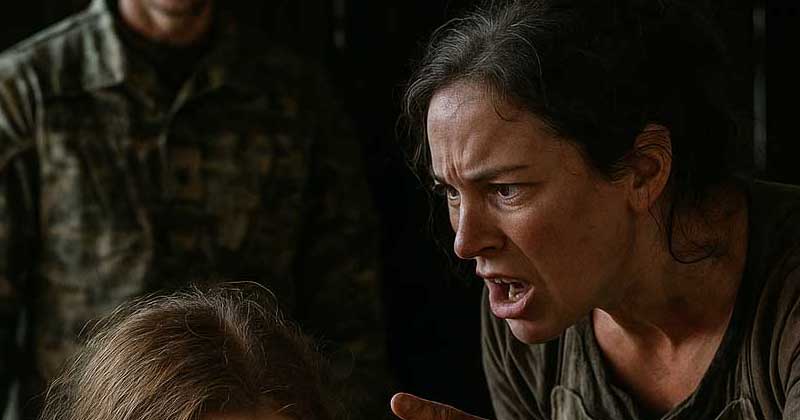
Miriam, the woman Toma had left his child with when he went to war, came out of the house. Her gaze was sharp but also filled with fear. She hadn’t expected to see him back so soon, and especially not prepared for his questions.
— Why is my daughter sleeping in a pigsty? Toma asked, in a low voice, but so powerful that it seemed to shake the ground.
Miriam tried to stammer something about shortages, about hardships, about misunderstandings. But in the man’s eyes, there was no room for excuses.
Neighbors, drawn by the shout, began to gather at the gate. People looked on, whispered among themselves, but no one dared to approach. It was like a silent judgment, with the whole village as witness.
Toma raised his hand and showed the letters.
— My child wrote these to me. And each of them tells the truth. It is not the eggs that are missing from the house, but kindness. It is not the bread that is the problem, but indifference.
In that heavy silence, Alma tightened her arms around her father even more.
Then, Toma did something no one expected. Instead of bursting out, instead of letting his anger burn, he sat on the doorstep with his daughter in his arms. He looked at the people and said:
— From now on, no child in this village will be left to cry from hunger or sleep in a pigsty. I have come home, and not just for my daughter, but for all the children here.
His words had the power of a sermon. People felt ashamed, lowered their heads. Some quickly brought bread, others milk, others clothes for the little girl.
The next day, the village church was full. The priest spoke about mercy and the duty of each person. And, for the first time in a long time, the village felt that it needed to be one big family, not just a collection of scattered houses in a valley.
Years passed, but that story remained. People still remember how a father returned from war and turned his daughter’s pain into a lesson for all.
And if you ask today in the village streets why no child goes hungry anymore, the elders will simply tell you:
— Because then, Toma Herrera came home and taught everyone what it means to be a parent.
This work is inspired by real events and people, but has been fictionalized for creative purposes. Names, characters, and details have been changed to protect privacy and enhance the narrative. Any resemblance to real persons, living or dead, or actual events is purely coincidental and not intended by the author.
The author and publisher do not assume responsibility for the accuracy of events or the portrayal of characters and are not liable for any misinterpretations. This story is provided “as is,” and any opinions expressed belong to the characters and do not reflect the views of the author or publisher.


