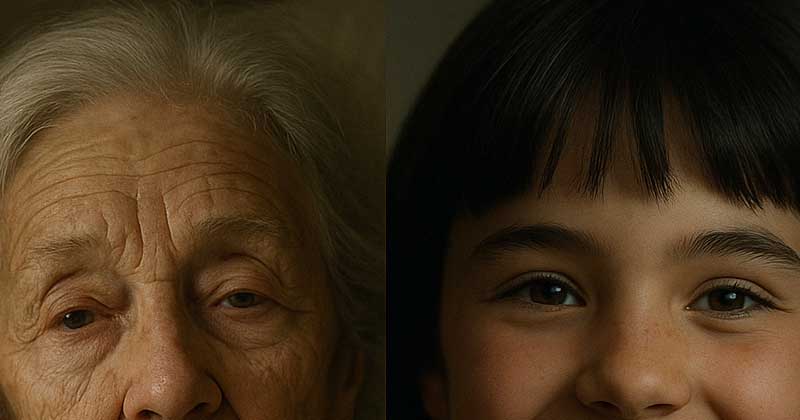
Radu examined the container closely, took off his gloves, and inspected the necklace. His dark eyes moved quickly, noting every detail. Rebecca recounted the entire discovery, her voice trembling as if she were reliving every moment of that summer day in 1999.
“We need to go there,” he finally said. “To the clinic.”
Rumors about Doctor Bălan were not new. In the village, some revered him as a man of faith and science, while others viewed him with suspicion, recalling the hurried consultations and the rooms always locked. But no one had ever had the courage to raise their voice against him.
That evening, Rebecca and the detective stood in front of the clinic. The building, once full of life, seemed deserted, with closed windows and long shadows falling over the main entrance. The air was filled with the smell of dust and mold, as if time had stopped there.
They entered. The floor creaked with every step, and the walls echoed with whispers. Radu pulled out a flashlight, and they followed the signs down to the basement. Room B7 did not appear on any official plan of the building, but the dark corridor had numbered doors.
When they reached the one marked B7, Rebecca felt her heart pounding so loudly that it drowned out her hearing. Radu forced the lock, and the door creaked open.
Inside was a small, cold room with cement walls. On a rusty shelf, old files were stacked in dusty piles. However, on the table lay something that left them frozen: photographs of Andreea, from childhood to adolescence, each labeled with a date. The last photograph was from the very day she disappeared.
Next to the photographs was a journal. The detective opened it, and the small handwriting revealed a chilling truth: the doctor had kept records of several girls, all from the area, all missing without a trace over the past two decades.
Rebecca felt her legs weaken. The image of the village, with its Sunday church, neighbors greeting each other over fences, and summer fairs where everyone laughed and enjoyed themselves, wavered before her. Behind that peaceful community, a monster had lived unchallenged.
“We need to find him,” Radu said gravely. “And we need to make things right.”
And then, from the dark corner of the room, a faint noise was heard. Rebecca held her breath. The flashlight illuminated a hidden space behind a wooden wall. A secret door.
They pushed it open with difficulty, and what they discovered beyond changed their lives forever. A small underground shelter, with clear signs that someone had lived there. On the bed, an old blanket, and on the wall, scratched with a nail, were the words: “I am here. Help me.”
It was Andreea’s signature.
Rebecca burst into tears. After sixteen years, the truth was coming to light. The community would learn who Doctor Bălan truly was, and the apparent tranquility of the village would be shaken forever.
That night, on Maple Street, people lit candles at their doors. It was no longer just about a missing girl. It was about an entire community that had to face its shadows and reclaim its dignity.
Rebecca, with the butterfly necklace clutched to her chest, knew that Andreea’s promise had been fulfilled: the truth had been found.
The end did not bring peace, but it brought justice. And in Romanian villages, where people still believe that “the truth comes to light like oil on water,” justice began to make its way, even after so many years.
This work is inspired by real events and people, but has been fictionalized for creative purposes. Names, characters, and details have been changed to protect privacy and enhance the narrative. Any resemblance to real persons, living or dead, or to real events is purely coincidental and not intended by the author.
The author and publisher do not assume responsibility for the accuracy of events or for how characters are portrayed and are not liable for any misinterpretations. This story is provided “as is,” and any opinions expressed belong to the characters and do not reflect the views of the author or publisher.


