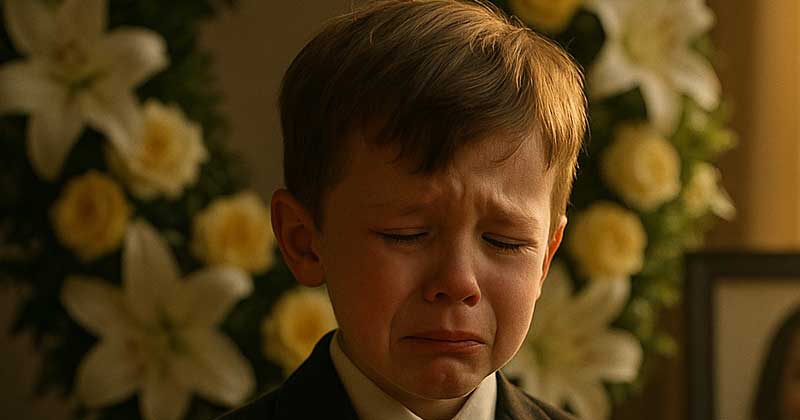
Everyone was stunned. The gazes turned to the child, who trembled, with wide, moist eyes, yet filled with determination. His voice was not that of one who invented, but seemed carried by something beyond human understanding.
The man, with a broken heart, grabbed the child by the shoulders. “What do you say, boy? What did you hear?”
“Last night,” the little one stammered, “mom came next to me and whispered that she is still alive, that we need to find her. She told me not to let anyone else put her in the coffin instead of her.”
A restless murmur passed through the crowd. An old woman from the village made the sign of the cross. Others began to whisper, caught between faith and fear.
Romanian tradition says that the voice of children does not lie and that the souls of the departed can show themselves to the innocent. The child’s words shook everyone.
An uncle dared to lift the cloth covering the body. He looked closely, and his eyebrows furrowed. “Brother… look more closely. The teeth, the hands… It doesn’t match.”
A commotion arose. The women cried louder, and the men approached cautiously. Doubt slowly crept into their hearts.
The husband, with tears streaming down his cheeks, gathered his courage. He looked at the body again. And then he saw: a scar on the arm that had never existed on his wife.
His heart tightened. “Holy Lord… The child is right.”
A wave of astonishment and fear swept through the room. Who was, then, the woman in the coffin? And where was his wife truly?
At that moment, the village’s old priest stood up, leaning on his staff. “We cannot bury the wrong body. We must find out the truth. God does not allow the truth to remain hidden.”
A few men gathered and decided to go back to the river. Evening descended over the village, and the sunset painted the sky red. They asked the child where his mother had said she was.
“At the place where the willows meet the water,” he replied softly.
They set off together, carrying lanterns and prayers. The river flowed gently, but the shadows of the willows seemed to hide secrets. Dogs barked in the distance, and crickets sang restlessly.
Suddenly, one of the men shouted: “Here!” They spotted something moving among the reeds. They approached with hearts pounding.
And there, exhausted but alive, stood the woman. She was wet, weakened, and with a dazed look, but she was breathing. She had been caught between the roots of the willows and clung to life with an inhuman strength.
Shouts of joy broke the silence of the night. Tears of sorrow turned into tears of gratitude.
They took her home, and the whole village experienced the miracle. The coffin, which was supposed to be sealed, remained empty, a testament to a story that would be told for generations.
And the child, with bright eyes, remained the living proof that sometimes, the voice of innocence carries the truth that adults can no longer hear.
Since then, the people of the village have remembered that the pure voice of a child can open doors that even death cannot close.
That family remained united, and their story became a local legend — a testament that love and faith can overcome even darkness.
This work is inspired by real events and people, but has been fictionalized for creative purposes. Names, characters, and details have been changed to protect privacy and enhance the narrative. Any resemblance to real persons, living or dead, or to real events is purely coincidental and not intended by the author.
The author and publisher do not assume responsibility for the accuracy of the events or for how the characters are portrayed and are not liable for any misinterpretations. This story is provided “as is,” and any opinions expressed belong to the characters and do not reflect the views of the author or publisher.


