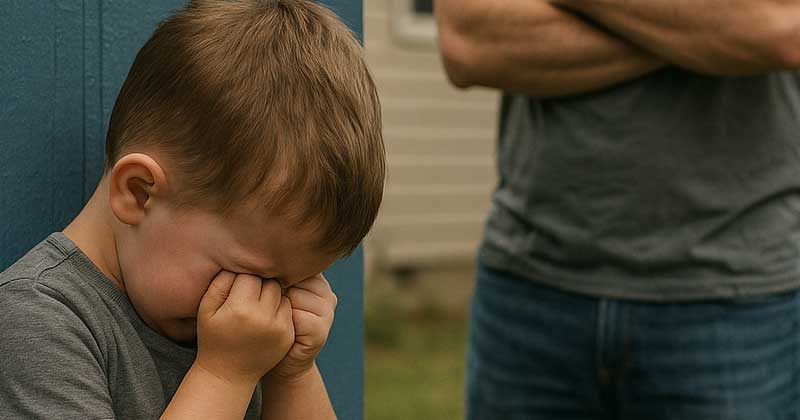
My heart raced, but not out of love or concern, rather from a deep, almost shameful fear. For years, I had convinced my soul that the child did not matter, that he was not my blood and therefore I had no obligation to him. And yet, the mere mention of him made me tremble.
I accepted the invitation. Perhaps out of curiosity, perhaps out of a premonition. On Saturday, I arrived at the elegant building of the gallery. White walls, warm light, well-dressed people whispering to each other.
On one of the walls, a huge painting caught my eye. It was a child with sad eyes, a torn bag hanging from his shoulder. I felt the ground slip from under my feet. It was him. It was exactly the moment I had chased him out of the house.
I felt a knot in my stomach. Someone touched my shoulder. I turned around. A tall young man, elegantly dressed, with a confident yet cold gaze.
— Good evening, father, he said simply.
The words struck me like a thunderbolt. The world around me seemed to disappear. All the years I had ignored him, all the times I told myself he didn’t matter, were now crashing down on me.
— I… — my voice broke.
But he did not wait for an apology.
— I did not come to ask for your forgiveness. Nor to reproach you. I came to show you what I have become without you.
He led me through the paintings. All were about loneliness, pain, loss, but also about rebirth. Scenes seemingly inspired by the stories of Romanian peasants, of children left orphaned after the war, of grandparents raising their grandchildren in abandoned villages.
In a corner, I spotted a painting of an old icon, hanging crookedly on a shabby wall. I recognized it immediately. It had been the icon from our country house, the one my wife carefully dusted every Sunday.
I felt tears burning my cheeks.
— I survived, he continued. I slept in train stations, worked day labor in villages, received a piece of bread from old women who had little to put on their tables themselves. And yet, Romania saved me. Simple people, with big hearts, gave me strength.
The audience applauded. I remained motionless.
— Everything I am today, I owe to the people you despised. Not to you.
He looked at me one last time, then turned to the other guests. I was left alone, like a stranger, amidst my own regrets.
For the first time in my life, I felt the true weight of the word “parent.” It was not about blood, but about soul. About not letting a child face the world alone.
I wanted to shout to him, to stop him, but it was too late. He was no longer the boy I had chased away. He was a strong man, an artist who had found his way.
And I was left only with shame.
The truth crushed me. Not because he succeeded without me, but because deep down I knew: I could have been part of his story.
And I wasn’t.
That night, I walked alone through the streets of Bucharest. The city lights reflected in my tears. In a shop window, I saw the icon of the Virgin Mary and stopped. I understood then that forgiveness could no longer come from him. I had to seek it within myself.
But I knew one thing: my story would remain a lesson. For in our culture, it is said that an orphan child is the “child of the village,” and the whole village raises him. I was the only one who chased him away.
And that was the greatest mistake of my life.
This work is inspired by real events and people, but has been fictionalized for creative purposes. Names, characters, and details have been changed to protect privacy and enhance the narrative. Any resemblance to real persons, living or dead, or to real events is purely coincidental and not intended by the author.
The author and publisher do not assume responsibility for the accuracy of events or for how characters are portrayed and are not liable for any misinterpretations. This story is provided “as is,” and any opinions expressed belong to the characters and do not reflect the views of the author or publisher.


