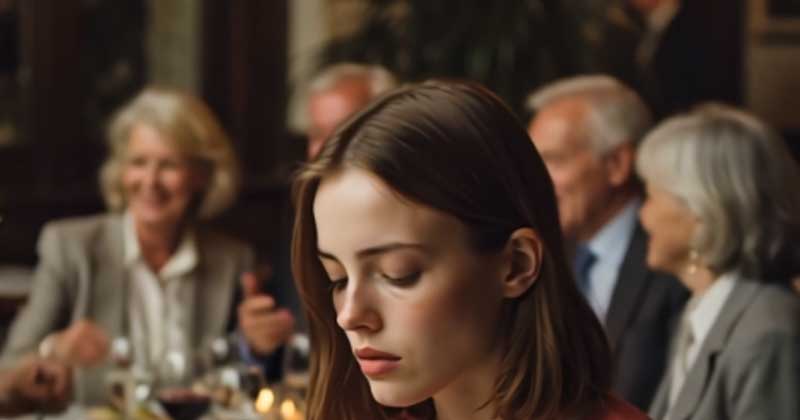
That morning began with a strange silence. The sun was rising over the sea, casting warm light over my balcony. I could hear others laughing from somewhere below, but within me, there was neither anger nor sadness. There was only clarity.
I went down early, before they gathered for breakfast. I left the room keys on the counter and discreetly signed a document at the reception. I requested to have my luggage moved to another villa in the complex, more secluded, near the beach. I didn’t want to run away, but to regain my space.
When they came down early and found the empty table where I should have been, their faces changed. Ion furrowed his brows, Elena began to fidget, and Mihai searched for me with his eyes, as if realizing for the first time that he could lose me.
But I was already on a sunbed, with a steaming coffee, watching the waves. For the first time in a long time, I felt peace. I was no longer struggling to be accepted. I was no longer begging for my place at their table. I had found my own table, with the sea as my only companion.
I grew up in a Romanian family where hospitality was an unwritten law. My mother never let anyone eat alone. In our home, meals were long, filled with laughter, hot soup, and sweet bread placed in the middle. Perhaps that’s why what they did hurt me so much. But now I understood that not everyone shares the same values.
Ion and Elena, with all their rigidity, could not take away what I had brought from home: the power to be human. In that moment, I knew I would never again accept being treated as a stranger in my own marriage.
Mihai came towards me, awkwardly trying to joke: “I see you’ve moved to luxury.”
I looked him straight in the eye and calmly replied: “I haven’t moved to luxury, I’ve moved to dignity.”
He fell silent. He knew I was right. He knew that for years he had silently asked me to be quiet and endure. But my patience had run out.
Throughout the day, the tension grew. I could see them whispering among themselves, disturbed by my silent “rebellion.” I hadn’t caused a scene, I hadn’t raised my voice. I was simply living my vacation by my own rules. And that was what unsettled them the most.
On the third day, when they tried again to isolate me at the table, I smiled and said: “No, thank you. Today I’m eating with my friends.” And I sat at a table where a couple from Cluj, also on vacation, had invited me to join them. We laughed, shared stories, and I felt the joy of a real meal once again.
My in-laws looked stunned. For them, my silence was stronger than any argument. Mihai, however, was faced with a choice he had been postponing: to remain a prisoner in his parents’ shadow or to build his own family with me.
That evening, in our room, I simply told him: “Mihai, I can’t live like this anymore. Either we are a team, or we each go our own way. I have found my peace, but you need to find your courage.”
The words hung heavily in the air. He looked at me, and for the first time in his eyes, I no longer saw indifference, but fear. The fear of losing me.
That vacation, which was supposed to be another attempt at humiliation, turned into a turning point. For them, it was the shock of discovering that they could no longer control me. For Mihai, it was a wake-up call.
And for me, it was a rebirth.
I learned then that you don’t need anyone’s approval to live your life beautifully. You only need the dignity to say “enough.”
And when I uttered that word within myself, the sea seemed to whisper in unison: “You are free.”
This work is inspired by real events and people, but has been fictionalized for creative purposes. Names, characters, and details have been changed to protect privacy and enhance the narrative. Any resemblance to real persons, living or dead, or to real events is purely coincidental and not intended by the author.
The author and publisher do not assume responsibility for the accuracy of events or for how characters are portrayed and are not liable for any misinterpretations. This story is provided “as is,” and any opinions expressed belong to the characters and do not reflect the views of the author or publisher.


