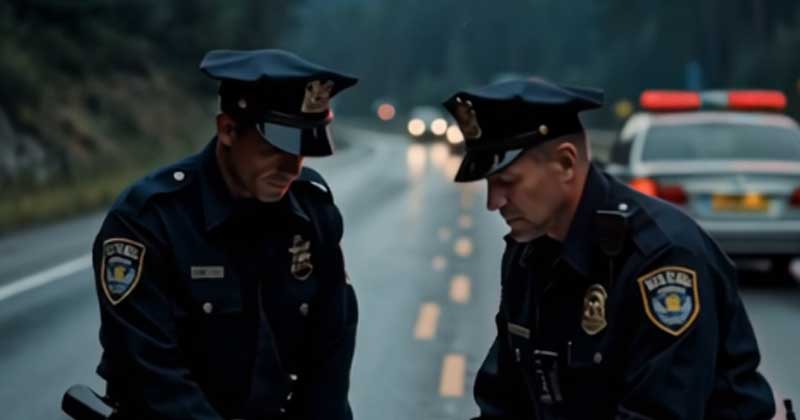
Inside, there was not what we expected. Neither a body, nor a mannequin, nor even mundane objects. The coffin was filled with lit candles, perfectly arranged, as if in a ritual. Their flames flickered strangely, even though the air was completely still.
I felt goosebumps on my skin. In a coffin, in the middle of the road, lit candles… it was something that defied logic. My colleagues took a few steps back, and Rex, the service dog, began to growl softly, his fur bristling.
At the bottom of the coffin, among the candles, there was an old, time-smudged icon. The face of the Virgin Mary was barely discernible, but the painted eyes seemed to look directly at us. Around the icon were scattered grains of wheat and a few red ribbons, like in an ancient custom.
— “This is not a joke,” one of my colleagues whispered. “It’s something older, something we don’t understand…”
I remembered my grandmother’s stories from Transylvania, who told me that sometimes, at the borders of villages, people left signs to ward off evil. The coffin on the road could be a kind of warning, a ritual meant to scare or stop something unseen.
I carefully extinguished the candles, one by one. The flame went out slowly, as if resisting. When I took the icon in my hand, a cold shiver ran through me, like a current passing through my whole body.
— “What do we do with this?” my colleague asked me.
I looked up towards the nearby forest. A heavy silence fell, and the birds, which had been chirping until then, suddenly fell silent.
— “We can’t leave it here,” I said. “It might be a sign. Some people still believe in curses, in connections between the living and the dead. If it was placed here intentionally, we need to know why.”
We lifted the coffin with the help of my colleagues and dragged it to the side of the road. I placed the icon in an evidence box, with all due respect.
On the way back to the station, my thoughts wouldn’t let me be. I was thinking of the elders’ words: “Nothing is random. Everything you see on the road is placed there for a reason.”
A few days after the incident, I received a call from a priest from a village not far from the location. He invited us to talk. When we arrived, the man greeted us with a heavy gaze.
— “I know what you found,” he said without introduction. “That coffin was supposed to stay there until sunset. It was placed to stop the evil that was haunting the village. Someone took the icon from the grave and brought it to the road, to bind the evil to the road, so it wouldn’t step into people’s yards.”
I felt a knot in my throat. The priest sighed and added:
— “Now that you’ve taken it, the evil might seek another path…”
I left the village with a deep unease. Maybe it was just superstition, maybe it was just folklore. But since then, whenever I patrol the deserted roads, I have the feeling that I am not alone.
The white coffin and that old icon have remained etched in my mind. And even though official reports only speak of “a suspicious object,” I know that I witnessed something that transcends ordinary rules.
Because sometimes, our roads are not just asphalt and dust. They are also made of beliefs, shadows, and memories deeply rooted in the soul of this Romanian land.
And anyone who dares to disturb them must be prepared: not everything placed on the road is meant to be taken.
This work is inspired by real events and people, but has been fictionalized for creative purposes. Names, characters, and details have been changed to protect privacy and enhance the narrative. Any resemblance to real persons, living or dead, or to real events is purely coincidental and not intended by the author.
The author and publisher do not assume responsibility for the accuracy of events or for the portrayal of characters and are not liable for any misinterpretations. This story is provided “as is,” and any opinions expressed belong to the characters and do not reflect the views of the author or publisher.


