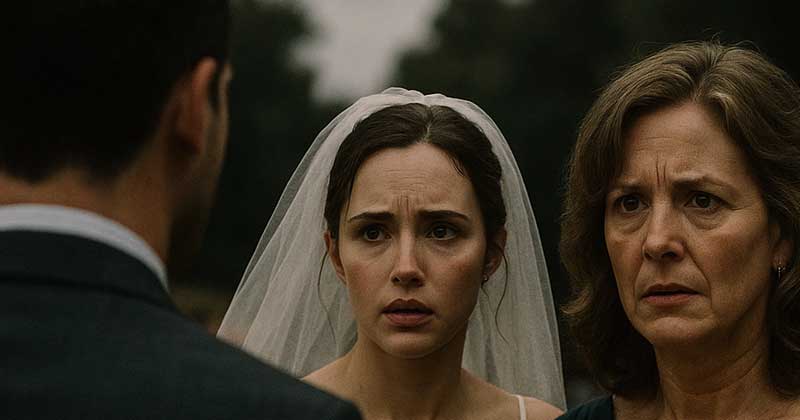
My words fell like a thunderbolt in the silence of the church. I looked her straight in the eye and said, in a firm but calm voice:
— If you love your son so much, then love his choice as well. In my village, the groom’s mother gives the bride bread and salt as a sign of blessing, not tears and quarrels. If you want to truly be his mother, show that you know how to let him be happy.
People murmured approvingly, and my respected, elderly uncle raised his voice:
— That’s right, woman! We, Romanians, have learned from our ancestors that at weddings we sing, dance, and bless, not tear the bouquet from the bride’s hands.
My mother-in-law turned red, and my husband found his courage. He turned to her and said for the first time, truly clearly:
— Mother, I respect you and will always love you, but now my life is with her. If you hurt her, you hurt me.
A deep silence fell, everyone was waiting to see what would happen next. I felt my heart pounding in my chest like a drum. In my mind, I pictured my hometown, where weddings were celebrated with musicians and dances until morning. I had never seen anyone ruin their child’s big day.
At that moment, the priest raised his hand and said:
— Weddings are sacred, and family should be a foundation, not a burden. I ask you, woman, to bless this marriage or to remain silent.
My mother-in-law tried to say something more, but the crowd turned against her. The godparents, relatives, and friends began to applaud, urging her to let go of her pride. Seeing that she had no choice, she lowered her head.
Then I made a gesture that no one expected. I took the bouquet she had snatched from me earlier, raised it in the air, and shared it, flower by flower, with the women around.
— Joy is not about having everything for yourself, but about giving, I said. And I choose to start my family life with a pure heart.
The guests erupted in applause, and the musicians started a joyful dance. My husband took my hand, and for the first time that day, I felt that we were truly a team.
The rest of the wedding was like a release. People danced, sang, and clapped until morning. When it was time to sit at the table, we respected the old custom: we shared the bride’s bread and sipped from a glass of red wine, a symbol of lasting love.
Even my mother-in-law eventually got caught up in the dance. Perhaps out of shame, or maybe because she realized she had lost the battle, but she danced nonetheless. People saw her and smiled, for after all, she was part of our story.
When dawn broke over the village, and the roosters crowed the awakening, I felt that I had gained more than just a wedding. I had earned the respect of everyone and, most importantly, the courage to defend my love.
That day I understood something that the elders always said, but I had not grasped until then: “Marriage is not built only on love, but also on the strength to face storms together.”
And perhaps my wedding began with tears and scandal, but it ended with a Romanian dance, with reconciled souls and the promise that true love cannot be defeated by anyone, not even by a jealous mother-in-law.
It was, without a doubt, the most tumultuous yet the most beautiful day of my life.
This work is inspired by real events and people, but has been fictionalized for creative purposes. Names, characters, and details have been changed to protect privacy and enhance the narrative. Any resemblance to real persons, living or dead, or to actual events is purely coincidental and not intended by the author.
The author and publisher do not assume responsibility for the accuracy of events or for how characters are portrayed and are not liable for any misinterpretations. This story is provided “as is,” and any opinions expressed belong to the characters and do not reflect the views of the author or publisher.


