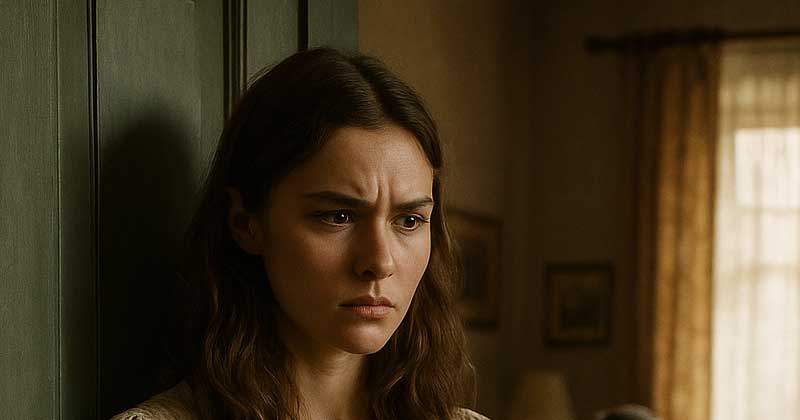
“Now she’s the only one bringing in money.”
A heavy, dense silence fell. Then her mother’s voice, sharp as a knife: “We both know this can’t go on forever. And when it collapses, you’ll be the one picking up the pieces again. I’m telling you, David, you need to think about what’s best for you.”
Emily’s knees buckled. The shopping bag slipped from her hands, and the oranges and bread rolled onto the porch. She barely noticed. Her world, already shattered, broke in two.
Inside, a chair scraped back from the table. Footsteps, then the smooth turning of wheels. She could no longer endure. She pushed the door open, her face numb, her eyes burning with tears she wouldn’t let fall.
David and his mother turned toward her under the warm light of the living room. The cheap chandelier swayed slightly above her head, the only witness to what was about to shatter.
“Emily,” David said, a hint of surprise in his eyes, quickly replaced by something that resembled guilt. His mother didn’t even blink; she just crossed her arms, her lips pressed into a thin, victorious line.
“Hello, my dear,” she hummed. “Tough day?”
Emily’s voice came out low and hoarse. “How long have you been planning this?”
David furrowed his brow. “Planning what?”
She stepped inside, kicking aside a rolling orange. “To get rid of me. To replace me. Whatever is on your mind, say it now.”
David’s mother let out a sharp sigh. “Don’t be dramatic, Emily. No one wants to replace anyone. We were just talking about what’s best for David. If you really cared, you’d understand.”
Emily stared fixedly at David: the man she had fed night after night, the one she had bathed and comforted in the dark hours when his shattered spine turned every breath into a struggle. The man she had embraced when the phantom pains kept him from sleeping. The man she had loved so much that she had given up everything—her own title, her own dreams—to keep him afloat.
And now he was there, sitting in front of the woman who had always seen her as a burden, letting her flounder in the wind.
“I’m sorry, Em,” he said slowly. “It’s just that… maybe Mom is right. Maybe you should take a break. Go to your sister’s for a while. Rest.” The word “break” gave Emily a bitter urge to laugh. A break? After all these years of supporting him while her own bones crumbled under the weight?
She looked at his mother. “And who will take care of him while I’m gone?”
The older woman didn’t blink. “We’ll find a solution. You’ve done enough, haven’t you?”
You’ve done enough. The words echoed in her head.
Emily felt her hands tremble. She wanted to scream, to throw the scattered groceries across the room. To remind everyone that she had done it all, that she had built her entire life around him when everyone else had left.
But she stood there, breath hitching, as David turned his gaze away, unable to look her in the eye.
That night, everything shattered.
Emily felt her heart beating irregularly, like a drummer who had lost the rhythm. She never thought she would hear such words, neither from David nor from her mother-in-law. And yet, they were there, cutting through the air, tearing at her soul.
In the heavy silence of the living room, a part of her wanted to run. To leave everything behind, just as others had done in the past. But another part, deeper, more rooted in who she was, held her upright. She had grown up with her mother’s teaching: “When troubles come, don’t run. Hold your head high and don’t forget who you are.”
She thought of the times she had gone to the fields as a child, helping her parents gather hay. She remembered how she would collapse on the furrow, her palms full of scratches but her heart light. There she learned that hard work was not a burden, but a covenant. An oath to family.
But here, now, that oath had been broken.
David was no longer the same man. It wasn’t just the accident that had changed him, but also the lack of courage to face his life. And more painful than the squeaking wheels of the chair on the floor was the fact that his silence told her everything she needed to know: he no longer saw her as the woman who had been his support, but as a burden.
Emily took a deep breath and lifted her chin. For the first time in a long time, she felt she was no longer trembling from weakness, but from a strength that was beginning to surface.
“I understand,” she said slowly but clearly. “If that’s what you think, David, then so be it.”
David looked up, surprised. He hadn’t expected that calm. He had expected tears, pleas, desperation. Not a woman who, after years of sacrifice, stood tall in front of him and his mother.
“Emily…”
She raised her hand and stopped him.
“No. There’s no need to say anything. I’ve washed enough dishes, carried enough bags, and gathered enough sleepless nights to understand that I was the only one who kept this house standing. If for you that’s ‘enough,’ then thank you. Thank you for showing me that I no longer belong here.”
David’s mother crossed her arms, a nearly imperceptible smile on her face. She thought she had won.
But Emily was not leaving defeated. She was leaving liberated.
She bent down, picked up a fallen orange from the floor, and placed it back in the bag. The gesture was simple, but in it lay all the dignity she had refused to let be trampled.
“In my village,” she said, “people used to say: ‘The woman carries the house on her shoulders.’ And that’s what I did. But from today, this house is no longer mine.”
She turned toward the door, each step heavy, determined. Her steps were no longer heavy with fatigue, but with the resolve of a person rising after being knocked down.
David reached out to her, but said nothing. He knew that any word would be too late.
As Emily stepped onto the porch, the cold night air hit her face. The sky had darkened completely, only a few stars twinkled in the distance. She wrapped her coat around her shoulders and stepped onto the rain-soaked path.
She didn’t know exactly where she would go. Maybe to her sister’s, maybe elsewhere. But she knew one thing for sure: she would never again allow herself to be reduced to a “burden.”
For the first time in years, she felt she was breathing freely. The light rain wet her cheeks, mingling with her tears. But they were tears of release, not defeat.
And as she walked away, Emily silently told herself that she would never look back.
That night, everything shattered. But from the shards, she would build her own life, stronger, cleaner, truer than ever.


