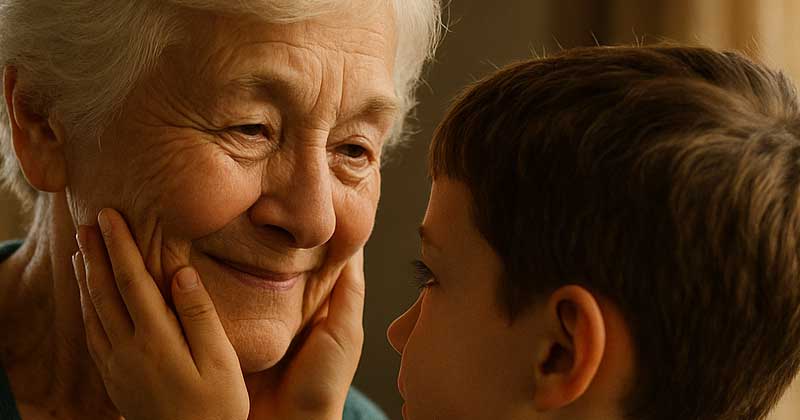
Tomás took the photograph with trembling hands. In the picture was a young woman, her hair styled in an elegant bun and a smile that seemed to light up the world. Next to her, a little boy of about five held her hand tightly.
It was Clara, many years ago, and the child in the photograph was his father.
His breath caught for a moment. He felt the past settling over the present like a heavy blanket, yet full of warmth. His grandmother had not forgotten entirely, and that little box was proof.
With moist eyes, he opened the letter. The paper smelled old, like a drawer kept for special occasions.
“My dear,
If you are reading these lines, it means I have lost a part of myself on the road of forgetting. I will forget faces, names, stories… but I want you to know that love does not fade. Please, when it is hard, bring me a wildflower. It will remind me that I am not alone.
And if, one day, I no longer know who you are, remember for me: that you are my grandson and that I love you with all my heart.
Yours, Clara.”
Tomás clutched the letter to his chest and felt tears streaming down his cheeks. All the suffering, all the loneliness, all the evenings when he felt lost beside her now made sense.
He turned to the nurse and hugged her, as if he wanted to embrace the whole world. Then he stepped outside, where the sunset colored the sky in shades of orange and violet.
In the courtyard of the nursing home, he lifted the wildflower he had held in his hand and placed it at the base of a fir tree. His grandmother had once told him, in a moment of clarity, that fir trees are the trees that do not lose their green, no matter the season. He wanted to leave a sign there that would not disappear.
That evening, at home, Tomás placed the photograph and the letter in a hand-carved wooden frame, just like he had seen at his grandparents’ house. He set it on the table, next to the family’s old icon and a small candle that burned quietly. It was his way of bringing her back home, among the living.
Years passed. Tomás grew up, finished school, and moved to the city, but he never forgot the ritual of the wildflower. Every year, at the beginning of spring, he would go to the village cemetery, pick a flower from the roadside, and place it on Clara’s grave.
Every time he did this, he felt a special peace. He was no longer just a grandson mourning his grandmother, but a man who understood the simple truth she had left him: that love does not disappear with memory.
And so, the story of Tomás and Clara became a lesson for everyone in the village. People remembered the boy with the backpack slung over one shoulder and the flower in hand, who passed through the park every day. They now saw him as a strong man, but always with a hint of childhood in his eyes.
Because deep in his heart, Tomás knew that it did not matter how much people forget. What matters is how much you remember them.
And one day, when he became a father, he took his daughter by the hand through the same park, showed her how to pick a flower, and said:
— Remember, my little one. A wildflower can keep a love alive forever.
The sky was turning red again at sunset, and Tomás felt his grandmother smiling, somewhere, among the gentle shadows of memory.
This work is inspired by real events and people, but has been fictionalized for creative purposes. Names, characters, and details have been changed to protect privacy and enhance the narrative. Any resemblance to real persons, living or dead, or actual events is purely coincidental and not intended by the author.
The author and publisher do not assume responsibility for the accuracy of events or for how characters are portrayed and are not liable for any misinterpretations. This story is provided “as is,” and any opinions expressed belong to the characters and do not reflect the views of the author or publisher.


