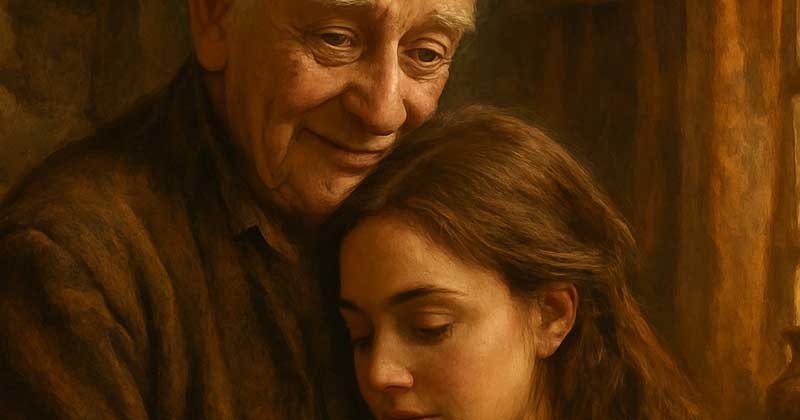
His words pierced me like a knife. Not because they were sad, but because they hid a rare, almost forgotten loyalty. In a world where everyone is always looking for something else, where people seem to change partners like clothes, Mr. Ernesto spoke of love as if it were a sacred vow.
I remained silent for a few moments, pretending to sip my tea. In reality, I was swallowing the tears that burned in the corners of my eyes. I remembered my beginnings with my husband, the days when we laughed together, the promises we had made to each other that now seemed dusty, forgotten in a drawer.
In the days that followed, I began to visit him more often. It was not just a job. It felt like a return to another life, simpler but fuller. I prepared his tea, read him the newspapers, helped him organize his medications, but in reality, he was the one who was “healing” me.
Every time I sat in front of him, I felt the silence fill with stories. He spoke to me about his travels around the world, about the bridges he had built as an engineer, about the faces of people he met in villages in Africa or Asia, where he learned that a person does not need much to be happy.
And then, in the same gentle voice, he would ask me about myself. He would ask simple but profound questions:
— What makes you happy, Laura?
— Why do you always smile only with your lips, not with your eyes?
I had no answers. Or perhaps I did not dare to say them out loud.
One afternoon, after he finished telling me about the young workers who helped him build a bridge over the Danube, he looked at me intently and said:
— You know, Mrs. Laura, life is like a dance. At first, you dance quickly, passionately, spinning around until you lose yourself. But later, the rhythm slows down. What matters is not to be left alone in the middle of the circle.
That image stuck to my soul. Perhaps I had been alone for a long time, even though I had a family. My house was full, but the emptiness inside me was enormous. And here I was, finding my peace in an old house, next to a man I had not even known until then.
Over time, I began to cook simple meals for him, just as I had learned from my grandmother: chicken soup with homemade noodles, cabbage rolls, fluffy sweet bread that filled the house with a sweet aroma. He enjoyed it like a child. He would always tell me that I made him relive the Sundays of old when his wife prepared meals for the whole family.
Sometimes, I would find him in the yard, leaning on his cane, looking at the wilted flowers in a garden that once had life. Then I would take a rake, and together we would try to bring color back to the dusty beds. He taught me the names of each flower, showed me how to plant them, how to water them “with patience, not in haste, for life does not feed on water poured in a rush.”
One evening, after we had cleared the tea cups, he said to me:
— Laura, you should know that you have made me feel young again. You have brought life back into my home.
I wanted to respond, but the lump in my throat held me back. The truth was that he had brought me back to life as well.
When I walked down the street, I felt that I no longer walked as heavily. I was no longer the tired woman who always rushed into the house, with a heavy soul and empty eyes. I had rediscovered the joy of talking, listening, and living.
And perhaps most importantly, I had rediscovered who I am. Not a woman abandoned by her husband’s attention, not a mother who had lost her purpose with her children’s maturity, but a living being still worthy of love, care, and respect.
Meeting Mr. Ernesto was not a job. It was a blessing. He taught me to slow down, to breathe, to listen to my soul. He showed me that even when everything seems lost, there is always someone or something that can reignite the light.
And so, in that house with old walls and a gate covered in ivy, I learned the most important lesson: that it does not matter how much you have lost along the way, as long as you manage to find within yourself the strength to love and to be loved.
This was the true payment. Not money. But my rebirth.
This work is inspired by real events and people, but it has been fictionalized for creative purposes. Names, characters, and details have been changed to protect privacy and enhance the narrative. Any resemblance to real persons, living or dead, or to real events is purely coincidental and not intended by the author.
The author and publisher do not assume responsibility for the accuracy of events or for how characters are portrayed and are not liable for any misinterpretations. This story is provided “as is,” and any opinions expressed belong to the characters and do not reflect the views of the author or publisher.


