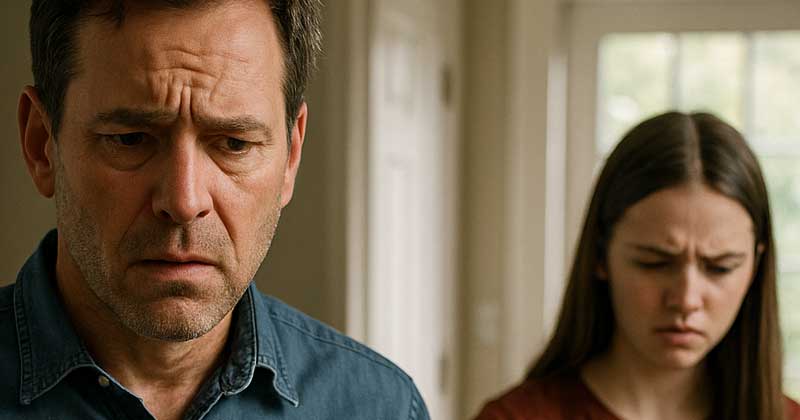
That night, Reuben stayed awake for a long time, staring at the empty glass. It wasn’t the first time he felt something breaking between him and his family, but now it was no longer just an impression. The word “failure” had embedded itself in his soul deeper than all the wounds he had gathered on the battlefields.
In the morning, when the house was quiet, he got up and began to gather documents, contracts, and a few personal items. He said nothing. No reproach, no tears. Everything unfolded with the same cold discipline he had learned in the army.
Before leaving, he stopped at the kitchen threshold. On the table, his daughter’s cup, decorated with colorful hearts, still smelled of tea. He touched it with the tip of his fingers, then turned away without looking back.
The road led him to the mountains. The highway wound through dense forests, and the smell of fir intoxicated him more than any drink. He stopped in a small village in the Apuseni Mountains, where the wooden houses still bore the marks of times gone by. There, people looked him in the eye and greeted him. They didn’t know who he was, they didn’t care what company he ran or how much money he had. He was just a man.
One evening, at the inn in the village, an old man told him: “You know, man, in this world, it doesn’t matter what others say. If you want to see who you really are, look at what remains when you lose everything.” These words haunted him like a calling.
He began to work alongside the villagers. He used his arms to carry wood, repair fences, and raise roofs. People respected him for his silence and seriousness. Slowly, he began to feel that he was finding a purpose.
On a Sunday, the church bells rang across the hills. Reuben entered and stood at the back, listening to the choir. He was not a religious man, but those simple, pure voices penetrated his heart. He remembered his childhood, the moments when his mother took him by the hand to church, and he felt protected.
Day by day, the tranquility of the village healed him. He began to smile, to enjoy small things: the smell of bread fresh from the oven, a reddish sunset over the peaks, the laughter of children playing in the street.
But the wound in his soul had not disappeared. One evening, he received a message. It was from Alisa: “Where are you? Tammy is crying. Come back home.” Reuben hung up the phone without replying. He knew she wasn’t crying for him. She was crying for the loss of comfort, for the support he had always provided.
For the first time, Reuben chose to think about himself. He raised his gaze to the starry sky and felt a peace he hadn’t experienced in many years.
In the village, people were already calling him “the stranger who found peace.” He had built a modest house on a plot at the edge of the forest. In the morning, he drank coffee on the porch and watched the sun caress the treetops.
He was no longer the soldier fighting in the desert. He was no longer the humiliated father or the betrayed husband. He was simply Reuben, the man who had chosen to rediscover himself.
And one day, when the village celebrated its feast, with dances and songs echoing across the hill, Reuben joined in the dance. His heavy steps, as a former soldier, aligned with the rhythm of the drums. For the first time, he no longer felt the burden of the past. He felt he belonged.
Then he understood the truth: he was not a failure. He was a man who had the courage to break the painful chains and seek his freedom.
And, in the glow of the villagers’ fireworks, Reuben smiled. The smile of a man who had finally found his place in the world.
This work is inspired by real events and people, but has been fictionalized for creative purposes. Names, characters, and details have been changed to protect privacy and enhance the narrative. Any resemblance to real persons, living or dead, or to real events is purely coincidental and not intended by the author.
The author and publisher do not assume responsibility for the accuracy of events or for the portrayal of characters and are not liable for any misinterpretations. This story is provided “as is,” and any opinions expressed belong to the characters and do not reflect the views of the author or publisher.


