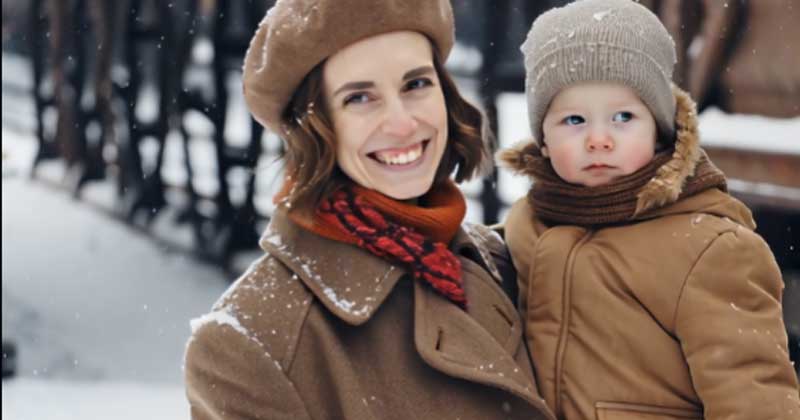
IN 1975, I FOUND A LITTLE GIRL BY THE RAILWAY TRACKS, I RAISED HER AND TAUGHT HER EVERYTHING, AND NOW SHE BOUGHT ME A HOUSE
— We are stuck at the railroad crossing again, Klavdia Petrovna sighs, adjusting her thick wool scarf. — What do you say, Anca, maybe we’ll be lucky and find a gold ingot on the tracks?
— Let’s be serious, I smiled. At most, you’ll find a frozen crow around here.
The November wind penetrated to the marrow of my bones. I was returning from my evening shift at the station, where I had worked for many years as a cashier. The sky hung so low that it seemed it could fall on our heads at any moment. The streetlights along the railway flickered, turning the way home into a strange dance of shadows and lights.
After Nicolae’s death — three years had passed, but the pain did not fade — I often stayed late at work. At home, I was greeted only by silence and a radio playing in the kitchen. Sometimes I wrote letters to my friend Tamara in Cluj-Napoca, but she rarely replied — she had three children and no time for correspondence.
That evening, I decided to take a shortcut through the reserve tracks. My legs were heavy with fatigue when I heard a sound. At first, I thought I imagined it. But it repeated — a faint whimper, like that of a kitten.
— Pss-pss, I said, looking into the darkness between the ties.
The sound became clearer. It was definitely a cry — the cry of a child.
My heart skipped a beat. I hurried towards the source of the sound, stumbling over stones and frozen ground. Behind a pile of old ties, curled up, was a little girl. In the dim light of my lantern, I saw her dirty face, full of tears, with big, frightened eyes.
— Oh my God, I whispered, kneeling down. — How did you get here?
The girl — about five years old — huddled even tighter and fell silent.
— You’re frozen all over, I touched her cheek. Cold as ice. — Come with me home, we’ll have tea with raspberry jam.
She didn’t resist when I picked her up. She was as light as a feather.
— My name is Ana Vasilevna, I told her as we walked home. — I live nearby. I have a cat, Vasile. He’s a bit mischievous — he pees in shoes if I forget to feed him on time.
The girl said nothing, but I felt her slowly relax, pressing against my shoulder.
Once home, I lit the stove. While the water was heating, I gave her warm soup. She ate eagerly but neatly, casting furtive glances at me.
— Don’t be afraid, I smiled. No one will hurt you.
After her bath, dressed in one of my nightgowns (which I had rolled up the sleeves of about ten times), she finally spoke:
— You really won’t throw me out?
— I really won’t, I replied, combing her tangled hair. — What’s your name?
— Elena, she whispered. — Elenuța.
The next day, at the police station, they could only shrug. No missing child reported. A young officer sighed with compassion:
— We have to take her to the orphanage. You understand, it’s the procedure…
— No, I said firmly. We are not taking her anywhere.
— Ana Vasilevna, he hesitated, but you are alone…
— So what? I can manage. I may not be young, but I have strength.
That evening, Elenuța, sitting in the kitchen with a cup of milk, suddenly asked:
— Why didn’t you have children?
I almost dropped the ladle:
— Who told you I didn’t have any?
— There are no pictures, she shrugged.
— Smart girl, I laughed. Maybe it just wasn’t meant to be. But now I have you.
She smiled — for the first time in those days — and I knew: I would never let her go. No matter what.
— Mom, why are you wearing that strange dress in the picture? Elenuța asked, holding an old photograph of me in my best crepe de Chine.
— It’s not strange, it was fashionable. I stood in line for that fabric for a year.
The adoption process took three months. Paperwork upon paperwork, endless offices, skeptical looks from officials. “Do you understand the responsibility? What will you do if the parents show up? How will you support her?”
I shrugged: “We’ll manage.” And at night, I counted coins, thinking about how to stretch my salary for two. I made dresses from old curtains, I sewed a coat for her from one of mine.
The neighbors whispered: “What does she need? She didn’t have children, she took a stranger. But what if she has bad genes?”
More insistent was Nina Ștefănescu from the first floor. When she saw us, she sighed and rolled her eyes:
— Ana, you’re going to have trouble with her…
Once, Elenuța couldn’t take it anymore:
— And you, Aunt Nina, are just jealous. Your son is grown and doesn’t even visit you.
I barely held back my laughter at the sight of her stunned face. At home, of course, I scolded Elenuța, but deep down I was proud — she was forming her character.
Life began to flow naturally. Elenuța started first grade, and I got a job as a janitor at her school — to be close. The teachers always praised her: smart, quick to learn.
In the evenings, we sat at the old table — I checked her notebooks while she did her homework. Sometimes, she would suddenly lift her head from the book:
— Mom, is it true that letters used to be written differently?
— Who told you that?
— A boy in class. He says his grandmother wrote with “wide i” letters.
— And what did you tell him?
— That now it doesn’t matter if it’s “wide i,” what matters is that we write without mistakes.
On rare weekends, we had small celebrations. We baked pies, made jam, and in winter, dumplings. Elenuța loved making them, even though she got covered in flour more than she filled the dumplings with meat. In fact, there was little meat, but at least we had something.
— Mom, look, this dumpling looks like our principal! she laughed, pointing to a misshapen dough ball.
— Give me the principal, I’ll put her in the soup, and that’s not nice…
Of course, there were also hardships. In sixth grade, Elenuța joined a group with older students. She started skipping school and responding rudely. I couldn’t sleep at night, wondering: where did I go wrong?
The climax: she ran away from home. A letter on the table: “Don’t look for me, I’m not your real daughter.” I went straight to the station — I felt she was there. And so it was: she was sitting on the bench where we had first met. Frozen, crying.
— And where did you want to go? I asked, sitting down next to her.
— I don’t know… she sighed. Everyone says you’re not my real mom.
— And what does a “real mom” mean? The one who left you in the cold?
— I’m sorry… she pressed against my shoulder. I won’t do it again.
At home, over tea with raspberry jam (just like the first evening), she asked me:
— Have you ever regretted taking me?
— Have you ever regretted staying?
We looked at each other and laughed.
Time passed unnoticed. Elenuța grew up, transformed. From a clumsy child, she became a beautiful girl. After high school, she decided to study medicine — she said she wanted to help people. I was happy: it meant that all those lessons in kindness were not in vain.
I remember how she came home after graduation — happy, with a medal on her chest. She sat down next to me on the couch:
— Mom, I was thinking… Some say nothing is accidental. Maybe it was fate for you to walk that path back then?
— Maybe, I smiled. But I’ll tell you: fate is fate, but the choice is ours.
That evening she told me for the first time about her past. About her alcoholic mother, the beatings, how she brought another man home and that man… Elenuța didn’t continue, but I understood everything. That’s when she ran away and never returned.
— For a long time, I was afraid you would become like her, she confessed. But then I understood: true love is not in blood, it’s in the heart.
When she had to leave for college, we both cried. I packed her suitcase with everything I could: clothes, some money, a jar of jam…
— Mom, stop making such a fuss, I’m not a child anymore!
— To me, you will always be a child.
Then came letters, rare calls from payphones, short visits during holidays. Elenuța did excellently, working as a nurse. I was proud of her and often told myself: how good it is that in ’75, I didn’t walk past indifferently.
I’m ashamed to admit, but there was a moment when I almost gave up. In the first year, the money ran out completely, and the salary didn’t even cover food. I was about to go to Child Protection… And then, my upstairs neighbor, Maria Ivanovna, brought me a bag of clothes — her granddaughter had outgrown them.
— Hold on tight, Anyuța, she told me. God didn’t send you this girl for nothing.
And I held on. I learned to sew, to patch, to make wonderful meals from nothing. Elenuța never complained, not even when she wore refashioned clothes, nor when she ate potato soup for three days in a row.
After her first internship in the hospital, we were in the kitchen, she with a cup of tea in her hands:
— Mom, I was thinking… Everyone complains about childhood in communism — that they had nothing. I only remember how we made dumplings while listening to “Theater on the Microphone,” how you braided my hair and told me stories. Even that dress made from your old skirt was my favorite — you even put lace on the bottom…
At her medical school graduation, the whole “family” came to the station. Klavdia Petrovna in her best suit, Zina the cashier with a huge bouquet of peonies. Even Nina Ștefănescu came — she was already walking slowly.
When Elenuța stepped onto the stage, I saw some acquaintances discreetly wiping their eyes with handkerchiefs. I remembered how they used to gossip…
— Anca, Nina said, touching my elbow. Forgive me, what a foolish old woman I was. Do you remember how I told you that you would suffer? Look at the girl you raised — a doctor! She didn’t bring you down, she brought you happiness.
I watched as my daughter, now Dr. Elena Anatolievna, received congratulations from her professors and thought: every wrinkle, every sleepless night, every patch — it was worth it. Oh God, how much it was worth…
And Elenuța… she became a real doctor. “With a gift from God,” her colleagues said. But to me, she was still that little girl by the railway tracks, who one evening changed my life.
And then… she bought me a house. Years later. Better let her tell you.
I had been planning this surprise for a long time. I saved, worked two shifts, did night shifts, invested wisely… I chose the house carefully — one floor, so she wouldn’t have to climb stairs, with a large garden for her peonies.
When I came to pick her up that March day, she was kneading dough for her famous pies.
— Elenuța, why didn’t you let me know? I would have cleaned up…
— Mom, forget about cleaning. Come on, we have work to do.
— What work? she wiped her hands on her apron. The dough is rising…
— Let it rise.
All the way, she tried to find out where we were going. I avoided the answer, my heart beating with excitement. When we entered a country road, she frowned:
— Eleno, you’re not taking me to a hospital, are you? I’m healthy!
— Even better, I winked.
At the gate of our new house, she stopped. A wide porch, bright windows, apple trees in the garden…
— People live beautifully here, she sighed.
— From today, you live here.
At first, she didn’t believe it. Then she cried. She walked through the rooms, touched the walls, as if she wanted to convince herself that she wasn’t dreaming.
— My girl, how much did all this cost you?
— And what did you think I was working for all these years in a private clinic? To freeze in that old apartment in my old age?
We stayed another week in the old apartment, packing memories. Every item had a story. The tablecloth where I learned to write letters. The chipped cup — broken on the first day, out of fear. My mother didn’t yell, she just glued it: “Now it’s special.”
The neighbors helped with the move. Even Nina Ștefănescu brought her famous “Napoleon”:
— Don’t forget us, Ancuța. Who will tell me the news?
In the new house, my mother flourished. She made a garden, planted flowers. In the morning, she drank tea in the gazebo, watching the sunrise. She said she had never slept so well — peace, birds singing.
Only sometimes I caught her wiping her eyes while looking at old photos. Especially the one with the Christmas tree — I was six years old, in a dress made from a curtain, so happy.
— You know, she told me one evening on the porch, it was dark, I was scared… But I thought: what if someone needs help?
— And how was it? I took her hand. You saved me, now I save you.
— Child, she stroked my hair like in the old days, you saved me long ago. From loneliness, from emptiness. After my husband died, I was lost. And you appeared — and life gained meaning.
Recently, I took a leave of absence and moved my practice to an annex of the house. I will consult here — anyway, half the city comes to me. And most importantly: I will be next to her.
In the evening, we drink tea with raspberry jam. But not in a cramped little kitchen, but on the spacious porch. Mom has a new tradition: she bakes pies for the nearby orphanage.
— Maybe, she says, someone there is waiting for their destiny.
And I look at her, thinking: what happiness it is to be able to thank someone who gave you life. Not the biological one, but the true one — full of love, care, and warmth.
And if the world says there are no miracles — I know: the great miracle happened on that cold November evening in 1975, when a lonely woman did not walk past a frozen child indifferently. Everything that followed is just gratitude for that miracle.
And now, every evening, I enter my mother’s room, tuck her in, and kiss her on the cheek — just like she did when I was little. And every time, she whispers to me:
— Thank you, my girl.
— Thank you, mom. For everything.
This work is inspired by real events and people, but has been fictionalized for creative purposes. Names, characters, and details have been changed to protect privacy and enhance the narrative. Any resemblance to real persons, living or dead, or to real events is purely coincidental and not intended by the author.
The author and publisher do not assume responsibility for the accuracy of events or for how characters are portrayed and are not liable for any misinterpretations. This story is offered “as is,” and any opinions expressed belong to the characters and do not reflect the views of the author or publisher.


