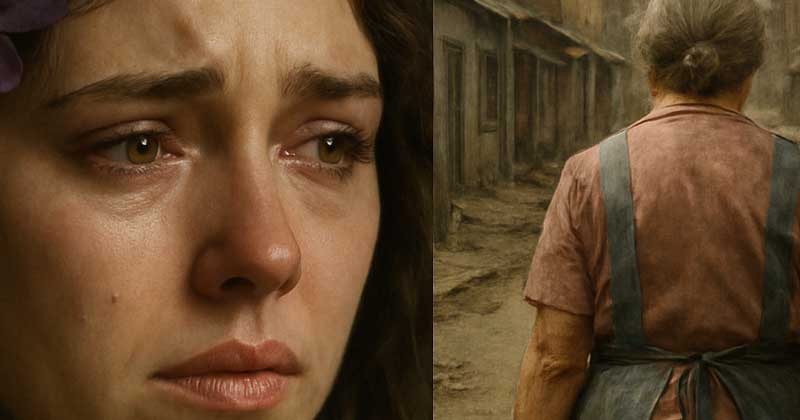
Lucero felt how every traffic light, every street corner pulled her into a foreign world, one she had kept at a distance until now. A world where dust, congestion, and the worry of tomorrow were part of everyday life.
The bus stopped in a rundown neighborhood, where the asphalt was cracked, and the houses seemed built with bare hands, without architectural plans. Barefoot children ran among the potholes, while women sold boiled corn and wildflowers brought from the market at the street corner.
Rosa got off with hurried but dignified steps. She didn’t seem ashamed of that place. On the contrary, she held her head high, with the same uprightness with which she carried her life.
Lucero pulled the car to the side of the street and got out, trying not to attract attention. She pulled her cap lower and started following the woman who had been by her side for so many years, without her even knowing who Rosa truly was.
They walked down a narrow alley, where the walls of the houses were covered with peeling paint and the smell of cooked food mixed with smoke from old stoves. In front of a small adobe house, Rosa stopped.
In the yard, two children sat on a wooden bench, sharing a slice of bread spread with margarine. Their smiles, though modest, had a light that shook Lucero.
Rosa entered the house, and for a moment, Lucero remained motionless, with teary eyes. It wasn’t a luxurious villa with Italian marble, but a simple house where every object seemed to tell the story of a struggle.
From inside, Rosa’s warm voice was heard:
— I’m here, my dears! Let’s wash our hands and then eat!
The children ran to her, embracing her with genuine joy. Lucero felt tears streaming down her face, unable to stop them.
She leaned against the low fence of the yard and remembered her own childhood. She had also grown up in a small house, with the smell of burnt wood and neighbors who shared their food in times of need. She had forgotten that world, caught up in the whirlwind of fame and luxury.
Now, looking at Rosa, she understood that true nobility did not lie in marble or carpets brought from the East, but in the love you put on the table next to a simple plate of rice.
Lucero took a deep breath and entered the yard. Rosa, surprised, dropped the spoon she was using to stir in an old pot.
— Ms. Lucero?! — she almost whispered.
— I wanted to know your world, doña Rosa — the artist replied, her voice trembling. — Forgive my boldness, but I needed to know.
Rosa’s eyes filled with tears, but not from shame, rather from the emotion of being truly seen.
— It’s not much here, but it’s all I have — she said. — My family.
Lucero approached the children, stroked their heads, and smiled. At that moment, she felt that scene was worth more than all the awards in her display case.
The next day, the press wrote about Lucero’s rehearsals, about the outfits she was going to wear. But she knew that the real lesson hadn’t been in the spotlight, but on that modest street, where love and dignity grew beyond poverty.
In a world where people judge by appearances, Lucero had learned that true beauty hides in the simplest places. And from then on, whenever Rosa entered her house, Lucero looked at her differently: not as an employee, but as a woman who carried within her a strength that no palace could offer.
And, in the quiet of her soul, Lucero knew that that afternoon had forever changed the way she saw people.
This work is inspired by real events and people, but has been fictionalized for creative purposes. Names, characters, and details have been changed to protect privacy and enhance the narrative. Any resemblance to real persons, living or dead, or to real events is purely coincidental and not intended by the author.
The author and publisher do not assume responsibility for the accuracy of events or for the way characters are portrayed and are not liable for any misinterpretations. This story is provided “as is,” and any opinions expressed belong to the characters and do not reflect the views of the author or publisher.


