It had barely been a few minutes when the engine of the black car stopped right in front of our house. I felt my knees go weak. Jonah stepped out onto the porch, wiping his sawdust-covered hands on his apron, not understanding anything.
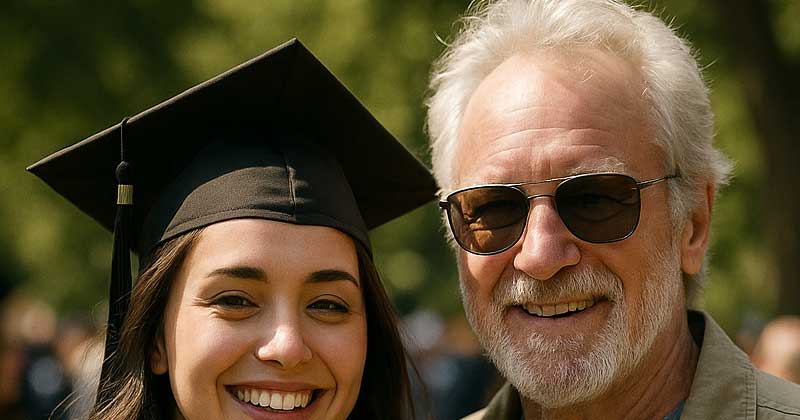
The door opened, and my father slowly got out. He looked older, with grayer hair, and his step was heavy. He was not the confident businessman but a tired old man, his eyes red from unspoken tears.
I froze. Behind me, the two little girls clung to my skirt, while the little boy giggled in Jonah’s arms. My father’s gaze fell on the children. His eyes filled with water.
— “Are… they mine?” he asked, barely whispering.
I shook my head. Silence settled between us like a wall. Then, unexpectedly, my father collapsed to his knees on the grass in front of the gate. He hid his face in his hands and cried.
Neighbors watched from behind the fence, but at that moment, no one else mattered. Just me, my children, and the man I had chosen against my father’s will.
Memories flooded over me: winter evenings when my father read me stories, the smell of sweet bread on Christmas Eve, the pride in his eyes when he called me “my little star.” I had lost him, but now, for the first time in three years, I had him back in front of me.
I slowly approached, my heart trembling.
— “Father…”
He looked up at me, his cheeks wet with tears.
— “Forgive me, Liana. I was a blind man. I thought I was giving you everything, but in reality, I took away the most precious gift: family. Now I see… and I have no strength left but to ask for forgiveness.”
Jonah, who had silently watched the whole scene, stepped forward. He was not a man to hold grudges. He approached and extended his hand.
— “Sir, your place is here, alongside them. I did not steal your daughter; I just loved her.”
In that moment, something changed. My father took Jonah’s hand, and their handshake sealed a reconciliation I had never thought possible.
In the days that followed, my father came by more often. He took the grandchildren for walks, brought them meaningful stories, and showed them games from his childhood, which I had once learned: “Country, country, we want soldiers,” “Hide and seek,” and tales of Făt-Frumos and Ileana Cosânzeana.
Slowly, our house filled with two kinds of laughter: that of the children and my father, who seemed to have grown younger. At Sunday dinners, when we took the stuffed cabbage out of the oven and the warm sweet bread from the table, I looked around and felt that, at last, the family was whole.
I realized then one thing: sometimes, to reach the light, you must go through the darkness. And love, no matter how tested, has the power to heal wounds that time alone could not close.
And one evening, when my father looked at me and called me “my little star” again, I knew that our story was not about loss, but about rediscovery.
In our hearts, we put the broken pieces back together and tied them with the thread of forgiveness. And there, amidst the laughter of the children and the arms of the one I chose, I found the greatest wealth: family.
This work is inspired by real events and people, but has been fictionalized for creative purposes. Names, characters, and details have been changed to protect privacy and enhance the narrative. Any resemblance to real persons, living or dead, or actual events is purely coincidental and not intended by the author.
The author and publisher do not assume responsibility for the accuracy of events or for how characters are portrayed and are not liable for any misinterpretations. This story is provided “as is,” and any opinions expressed belong to the characters and do not reflect the views of the author or publisher.


