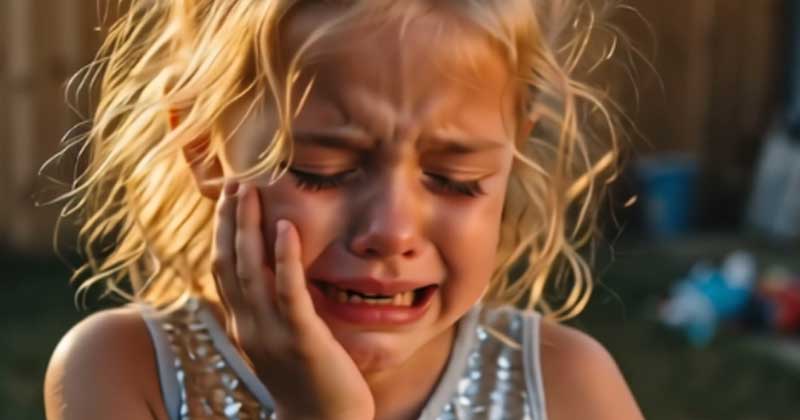
Everything came to a head at our nephew’s birthday party. The celebration was filled with children running around the yard, colorful balloons hanging from the fence, and a huge cake with seven candles. Ellie, dressed in a blue polka-dot dress, could hardly wait to play with the others. But her joy was suddenly shattered.
Carol approached her with a fake smile, leaning down to whisper something in her ear. After a few seconds, I saw my daughter’s face contort and her eyes fill with tears. Then, without saying anything, my mother-in-law led her to the gate and told her that “she didn’t belong there because she wasn’t family.”
My heart sank when I saw Ellie standing alone in the street, holding her favorite toy to her chest and quietly crying. I immediately took her in my arms, and at that moment, I felt I could no longer remain silent.
Inside, laughter and music mingled with the smell of pastries and orange juice. But I felt a terrible coldness. I approached Carol and told her, with a trembling but firm voice, that she had crossed a line. “You kicked a six-year-old out of a party because you don’t like her? That’s not just disrespect; it’s cruelty,” I said.
People turned in surprise, and silence fell over the yard. Daniel, visibly embarrassed, immediately stood up and came over to me. He looked at his mother and, with a voice I rarely heard so determined, said, “Ellie is my daughter. Anyone who doesn’t accept her doesn’t accept me either.”
At that moment, I felt I was not alone. Family means love, not blood. It’s not about who gave birth to you, but about who stands by you when the whole world rejects you.
I left the party holding Ellie’s hand, and Daniel followed us. We went home and organized our own celebration. We put leftover sweet bread from the weekend on the table, some apple pies, and lit colorful candles on a simple cake. It didn’t matter that it wasn’t the big, fancy cake from the official party. For us, it was more than enough.
Ellie blew out the candles laughing, and bits of whipped cream stuck to her cheeks. In her eyes, I saw again the light that Carol had shattered in just a few seconds. I knew then that my duty as a mother was not just to raise my child, but to protect her from injustice and show her what true love means.
Since then, I have set clear boundaries. There is no room for my mother-in-law’s venom and coldness in our lives. At family gatherings, if she is not willing to see Ellie as her granddaughter, then we prefer to stay away. Life is too short to fill it with resentment and hate.
In our culture, children are the blessing of the home. In my grandparents’ village, no one would let a child leave hungry or crying alone at the gate. It was always said that “whoever drives away a child drives away their luck.” And I firmly believe that these words still hold true.
Today, Ellie knows she is loved. She knows that her dad Daniel chooses her every day, that I will always protect her, and that family is not about coldness and rejection, but about open arms and a pure heart.
And the lesson I gave to my mother-in-law was simple: you can turn your gaze away from an adult, but never from a child. Because a child who cries at the gate because of you will always be the mirror of your lack of humanity.
And we, those who choose to love, will move forward with our heads held high, knowing that true family is built through the heart, not through blood.


