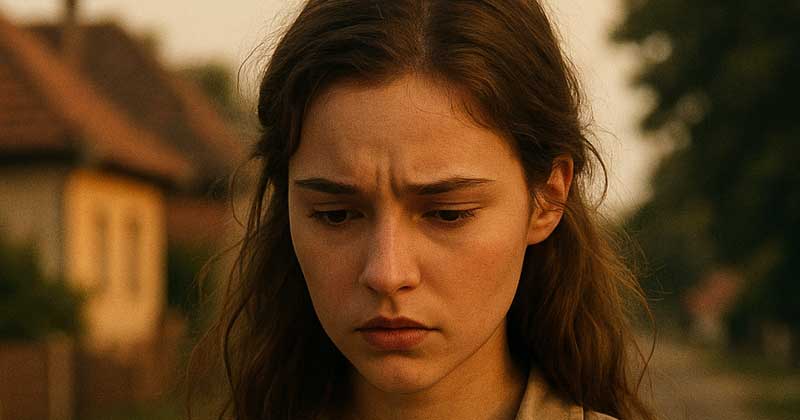
Her footsteps echoed softly on the dirt road, and the cold wind ruffled the edges of her coat. The village was quiet, with old houses, large carved wooden gates, and smoke lazily rising from chimneys. From a yard, an old woman was feeding a few chickens, while the dog tied at the gate barked more out of boredom than anger.
Olga stopped. She didn’t know anyone there, but something pushed her forward, as if that place had been waiting for her. The image of the envelope in her bag kept coming back to her mind. She felt it heavy, as if the old paper concealed a stone.
Arriving in the village, she entered a small grocery store. A woman with a headscarf and gentle eyes said to her:
— Good day, dear girl. I haven’t seen you around here. Are you looking for someone?
Olga shook her head no. She bought a round, warm loaf of bread and went out. She took a bite of it on the way, tasting not just the bread, but also the peace she hadn’t known for a long time.
In a nearby yard, she spotted an old, abandoned house. The windows were dusty, and the fence barely stood. Yet, her heart told her that she had to stop there. She pushed the gate and entered. The floor creaked under her steps, but inside it was dry, warm from the sun filtering through the cracks in the shutters.
She sat down on a rickety chair and took out the envelope. She looked at it as if it were a treasure or a burden. Her father-in-law had recently passed away, and that message left for her seemed to be the key to answers she had never truly sought.
She sighed deeply and tore open the envelope. Inside was a letter. The paper smelled old, and the ink was slightly faded. She read softly:
“Olga, I know it has been hard for you. I have seen how you lived for years in a house where you never felt at home. I remained silent because I too carried the burden of silence. But now, after I am gone, I want to tell you something I have hidden for years. The house on the hill, the one with the old walnut tree in the yard, belongs to you. I put it in your name since you married my son. I knew that one day you would need a place of your own, where you could find yourself. You were more than a daughter-in-law to me; you were like a daughter. I leave you this house and, along with it, the freedom you may not have known until now.”
Olga felt tears streaming down her cheeks. All the years of suffering, silence, and helplessness seemed to flow away with those tears. Freedom was not just a word, but a house, a road, a new life.
The next day, she climbed up the hill. The house described in the letter stood there, with the old walnut tree at the gate, just as it had been written. The leaves of the walnut had fallen to the ground, leaving the bitter scent of autumn, but in her heart, a warm light ignited.
The neighbors came to ask her who she was. When she told them her name, they immediately understood:
— Ah, you are the daughter-in-law of old Andrei. May God rest his soul; he was a good man!
And then they welcomed her as one of their own. A woman brought her a pot of soup, a man fixed her fence, and the children ran around the yard, reminding her of a childhood she hadn’t tasted in a long time.
On cold evenings, she would light a fire in the stove and watch the flames dance. She told herself that she was finally living. She had found her place, not because someone had given it to her, but because, in the end, she had the courage to leave.
The letter from her father-in-law was not just a material gift, but a blessing, a hand extended beyond death. And in that small village, among simple people, Olga understood something she had forgotten: that peace and freedom are not demanded, but built.
One morning, as the sun rose over the hills, Olga opened the window and took a deep breath. The village was slowly waking up, and the church bell rang. For the first time in many years, she was no longer a guest in her own life. She was home.
This work is inspired by real events and people, but has been fictionalized for creative purposes. Names, characters, and details have been changed to protect privacy and enhance the narrative. Any resemblance to real persons, living or dead, or to real events is purely coincidental and not intended by the author.
The author and publisher do not assume responsibility for the accuracy of events or for how characters are portrayed and are not liable for any misinterpretations. This story is provided “as is,” and any opinions expressed belong to the characters and do not reflect the views of the author or publisher.


