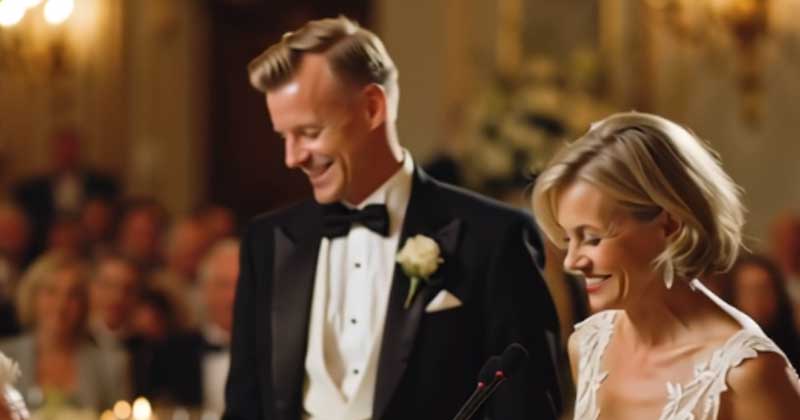
Maria gently clasped her hands around the microphone. The spotlight fell on her face, and her eyes sparkled with emotion. She was not used to so much attention, but this moment was not for her — it was for the son she had raised alone, with toil and tears.
“My dear ones,” she began, with a warm but firm voice, “I know I may not look like the person you expected to see here before you. Perhaps my clothes are not as expensive as others. Maybe my hands bear the marks of hard work. But in these hands, I held a child, cared for him, fed him, and taught him what respect and honesty mean.”
In the hall, a few heads bowed, embarrassed. The groom, sitting next to his wife, had moist eyes.
“It’s true, I didn’t finish school,” Maria continued, “but I learned something else: dignity is not given by a title, but by how you carry your soul. And today, when I see my son next to the woman he loves, I know that all my sacrifices have had a purpose.”
Only the crowd’s breathing could be heard. In a corner, the bride’s father crossed his arms, but his gaze softened.
Maria stepped forward. “When I was little, my grandmother used to tell me that life is like a wedding in the countryside: it doesn’t matter how big the tent is or how many dishes you have on the table, but whether people dance with open hearts. Today, I want to invite you all to dance with your souls, to set aside pride and enjoy their love.”
A warm murmur rose from the audience. Some began to applaud. Maria smiled, set the microphone down, and turned to the newlyweds. She embraced them tightly, as only a mother knows how to do.
And then something unexpected happened. The bride’s father stood up and came over to her. “Maria,” he said, “I think we have much to learn from each other. I’m sorry for how I judged you.”
The hall erupted in applause. The music started again, and the dance floor filled up. Maria, with tears in her eyes, took her son and daughter-in-law by the hand. Under the gentle light of the evening, people danced side by side, rich and poor, young and old, without caring about what clothes they wore or what profession they had.
It was an evening where prejudices were left at the door, and hearts united in the simplest and purest way possible: through love.
And long after the lights went out and the tables were cleared, everyone present knew they had witnessed something more than a wedding — they were witnesses to a moment of truth and human beauty, as rare as it is to see.
This work is inspired by real events and people, but has been fictionalized for creative purposes. Names, characters, and details have been changed to protect privacy and enhance the narrative. Any resemblance to real persons, living or dead, or actual events is purely coincidental and not intended by the author.
The author and publisher do not assume responsibility for the accuracy of events or the portrayal of characters and are not liable for any misinterpretations. This story is provided “as is,” and any opinions expressed belong to the characters and do not reflect the views of the author or publisher.


