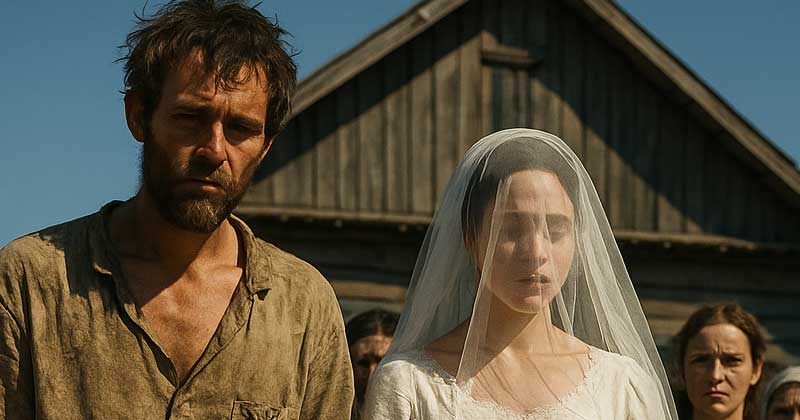
Zainab felt the ground slip away from under her feet. Alina’s words pierced her soul like knives: “Do you know who he is? He is not just any beggar. He is the son of a wealthy merchant who stubbornly chose to live among the poor just to punish his father. You have been handed over to him as a punishment, as a mockery. Not because someone loved you.”
Zainab stood still. The whole world seemed darker than ever. She walked home with heavy steps, and that evening she remained silent, not responding to Yusha’s simple and warm jokes. He sensed something but did not ask.
Days passed, and doubt gnawed at her soul. She listened to him describe the sunrise, but her sister’s words echoed in her mind. One night, gathering all her courage, she asked him:
– Why did you agree to marry me?
A long silence followed. Only the crackling of the wood in the stove could be heard. Then Yusha’s voice came, gentle yet firm:
– Because on the day your father pushed you towards me, I saw something that others have never seen. You don’t need eyes to shine. You have a pure heart, and I… I needed that. Yes, I was the son of a merchant, but money only brought me lies and betrayals. I chose to leave, to live simply, and only then did I feel what freedom means.
Zainab felt tears streaming down her cheeks. Not from pain, but from relief. In her heart, something had settled in the right place.
In the weeks that followed, news spread through the village: the blind girl lived in the beggar’s hut but laughed more often than the women in the big houses. People passed by the hut and stopped to listen to Yusha’s songs and Zainab’s laughter. Some even brought their children there to tell them stories.
But her father could not accept this. Humiliated by the fact that his “curse” was living happily, he became furious. One evening, he stormed in, shouting and threatening:
– I’m taking my daughter back! She has no place with a nothing like you!
Yusha stood up to him, unafraid:
– She is no longer yours. This is her home, this is her family.
For the first time, the father saw that his daughter, whom he had always called a “burden,” stood tall, head held high, holding her husband’s hand. Zainab spoke with a strength she had never felt before:
– Father, you made me believe I was nothing. But today I know I am worth more than all your gold. You can cast me out, you can hate me, but you cannot take away what I have found here: dignity and love.
The man was speechless. He left without saying anything, but the eyes of the villagers followed him. He was no longer respected as before.
Years passed, and their hut transformed into a small but lively home. Yusha worked with his hands, and Zainab prepared bread and cheese that the villagers praised as “made with soul.” Every evening, people gathered to listen to their stories, and the children grew up dreaming further.
One day, as the sun set over the hills, Yusha took Zainab’s hand and said:
– If the world did not give you eyes, it gave you a heart that sees further than anyone.
She smiled and replied with a trembling voice:
– And you showed me that happiness does not lie in what we see, but in what we feel.
And the whole village knew, without a shadow of a doubt, that the blind girl and the “beggar” were the richest of all.
This work is inspired by real events and people, but has been fictionalized for creative purposes. Names, characters, and details have been changed to protect privacy and enhance the narrative. Any resemblance to real persons, living or dead, or to real events is purely coincidental and not intended by the author.
The author and publisher do not assume responsibility for the accuracy of events or for how characters are portrayed and are not liable for any misinterpretations. This story is provided “as is,” and any opinions expressed belong to the characters and do not reflect the views of the author or publisher.


