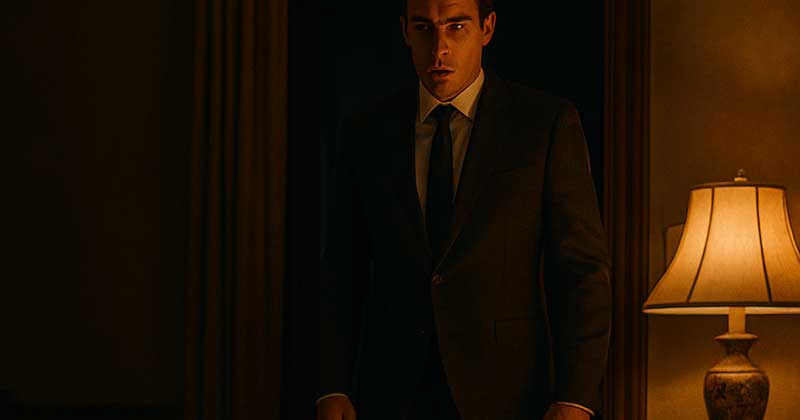
The governor hesitated for a moment at the other end of the line. It seemed she was weighing her words carefully.
— Mr. Whitmore, she is not just a maid. Her name is Maria. She stayed late last night because the children’s nanny left abruptly. Maria took them in her arms and stayed with them until they fell asleep.
Ethan remained silent. It had never happened to him that someone from the staff would bypass strict tasks without his approval. And yet, the image from last night haunted him.
He descended the stairs slowly, like a man stepping onto unfamiliar ground. In the kitchen, Maria stood upright in her turquoise uniform, preparing the children’s bottles. Her tired but gentle eyes lifted to meet his.
— I apologize, sir, she said in a trembling voice. I didn’t mean to break the rules. But the children were crying, and there was no one else. I held them in my arms to help them sleep.
Ethan felt a lump in his throat. His entire life had been built on rules, contracts, schedules, and power. But here, in front of him, a simple woman had told him something more powerful than any business strategy: the children didn’t need rules; they needed warmth.
— And you fell asleep with them in your arms… he murmured.
Maria lowered her gaze. — Yes. I have a child at home too. I know what it’s like to hear them cry and have no one to comfort them.
Her words pierced him like a knife. For the first time in a long while, Ethan looked at his own sons not as heirs to an empire but as small souls in need of love.
In the following days, Maria stayed with the twins more than any other employee. She sang softly lullabies, the same ones she had learned from her grandmother in a Romanian village: “Nani, nani, puiul mamii…” The children would calm down immediately, and Ethan, from the shadows, observed everything.
For the first time in years, he remembered his own childhood. He saw his mother kneading bread in the oven, the smell of burning wood from the stove, the long winter evenings when the whole family gathered around stories. And then he realized how much he had lost in his pursuit of money and power.
One evening, he could no longer resist and asked her:
— Why do you do this, Maria? Why care so much when no one asks you to?
She smiled slightly. — Because that’s how I was raised. In our village, children were not just the parents’ responsibility; they belonged to the whole community. If a child cried, anyone would take them in their arms. That’s how it was done. That’s how it seems natural to me.
Ethan was left speechless. In his world of skyscrapers and bank accounts, such a simple truth sounded like a revelation.
Days turned into weeks, and the twins grew up peacefully. When they laughed, Maria was there. When they woke up at night, her voice calmed them. Ethan, on the other hand, began to change his schedule. He canceled meetings and stayed home more often.
One morning, he caught his sons happily babbling on the carpet, while Maria sang them a folk song about longing and hope. The twins laughed with their toothless mouths, and Ethan’s heart filled with a warmth he had never felt before.
Then he understood. His wealth was not in stocks, buildings, or accounts. His true wealth was in those two small hearts beating next to his. And the simple woman, who unknowingly reminded him of what true love means.
That evening, Ethan sat next to Maria in the living room.
— You are not just the maid. From now on, I want you to be their caregiver. Stay close to them, give them that warmth that I alone cannot provide.
Maria’s eyes filled with tears. Not for money, not for position, but because she knew these children would not grow up lacking love.
Ethan Whitmore, the cold and distant millionaire, had learned the greatest lesson of his life: that a child’s soul is nourished not with wealth, but with warm arms, simple songs, and a heart that beats alongside theirs.
And for the first time, he was no longer afraid of the silence in the mansion. Because beyond the luxurious walls, the most precious sound in the world now echoed: the laughter of his children.
This work is inspired by real events and people, but has been fictionalized for creative purposes. Names, characters, and details have been changed to protect privacy and enhance the narrative. Any resemblance to real persons, living or dead, or to real events is purely coincidental and not intended by the author.
The author and publisher do not assume responsibility for the accuracy of events or for how characters are portrayed and are not liable for any misinterpretations. This story is provided “as is,” and any opinions expressed belong to the characters and do not reflect the views of the author or publisher.


