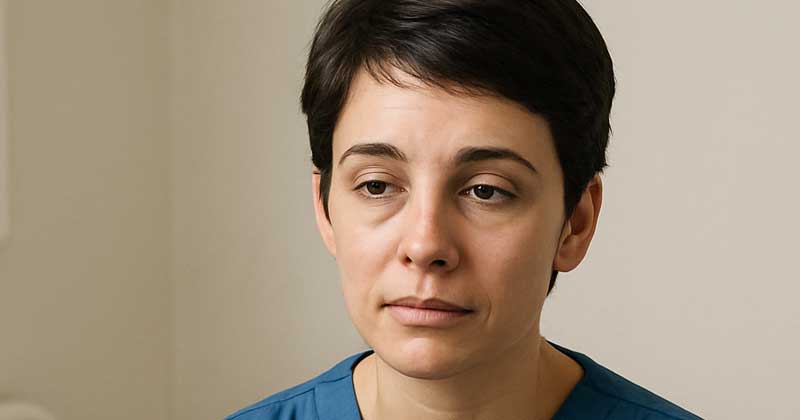
Today was like any other day. Catinca stepped into the hallway. “Are you Catinca?” She turned abruptly. In front of her stood that very patient. Behind him were two bald men, and he was holding flowers. “I just returned from Germany today, from treatment. Catinca, I never imagined you would be so beautiful.”
A candle could be lit from Marina’s face.
— “Catinca, tell me, when could you go with me to a restaurant and, in general, stroll through the city?”
It seemed that he had…
Catinca was left speechless. She looked at the man who, just a month ago, had been brought in on a stretcher, crushed and almost lifeless. Now he stood before her, elegant, in an expensive suit, with a confident air, but with a warmth in his eyes that reminded her of that night when he whispered pleas on the hospital bed.
He handed her the flowers, and she, trembling, took them. An avalanche of gazes focused on her from the hallway: nurses, orderlies, even curious patients. They all whispered. And Marina, with her lips pressed together, had lost any trace of superiority.
“You shouldn’t have bothered…” Catinca tried to say. But he gently interrupted her: “No, I had to. If it weren’t for you, maybe I wouldn’t be here today. You gave me a second life.”
The invitation to the restaurant seemed straight out of a movie. Catinca, the simple girl raised on the outskirts of the city, who had only wanted to be a good nurse, was now seen as the heroine of a story. But she felt the weight of reality. She feared that all this light could blind her.
Still, she accepted. Not for the glamour, not for the luxury that such a meeting promised, but because, in his voice, she recognized the same vulnerability of the man who had held her hand in the dark ward, imploring her to listen.
That evening, at the restaurant, the world seemed to stop for the two of them. The candles lit the tables, and the live music brought an air of elegance. He told her that his name was Andrei and that he was the son of one of the most influential people in the country. He had quarreled with his father, run away from home, tried to live the life of ordinary people, but had ended up being destroyed by those he had trusted.
“If it weren’t for you, I might have remained there, on the streets, forgotten by everyone,” he confessed, looking at her with gratitude.
Catinca listened and seemed to see behind his story the pains of many people she had met in the hospital. She thought of her grandmother’s village, where the elderly used to say that “a person is known not by what they have, but by how they lift up another who has fallen.” That simple wisdom echoed in her mind now.
— “Andrei, I didn’t help you for who you are or for your father. I did it because it felt right. That’s how I was raised: not to leave a person in need.”
His eyes welled up. “Then it means you are the only one who saw me as a person, not as an heir.”
From then on, their meetings became more frequent. Catinca taught him the simplicity of things: what it’s like to walk the streets of a provincial town, to eat warm pretzels at a street corner, to enjoy a sunset over sunflower fields. He, in turn, opened doors to a world he had never imagined.
In the hospital, rumors grew like grass after rain. Marina boiled with envy, but others looked at Catinca with respect and even pride.
Months passed. One spring morning, Andrei came for her in a simple car, without guards, without extravagance. “Today I want to take you somewhere.”
They arrived in a small village in Transylvania. It was Catinca’s grandmother’s village. There, among the old houses and narrow streets, he stopped and said to her: “Here I feel like I can truly breathe. Thank you for showing me what it means to be human.”
On the porch of the old house, amidst the smell of freshly baked bread and the song of roosters, Andrei knelt before her. He took out a ring and simply said, with a trembling voice:
— “Catinca, will you be my wife?”
Her heart raced. She had never thought that life would bring her such a turn. But looking at him, she remembered the fallen man she had cared for with all her being. And she understood that fate had chosen for both of them.
— “Yes, Andrei.”
At that moment, the whole village seemed to resonate with joy. Neighbors gathered, children ran through the yard, and the church bells rang as if for a celebration.
Catinca’s story, the girl who only wanted to be a good nurse, had become a life lesson: when you put your heart into even the smallest gestures, God sends you back more than you ever dreamed.
And so, amidst the smell of freshly cut grass, laughter, and the song of the nai, Catinca and Andrei began their love story, one that would be remembered for a long time as proof that true goodness changes destinies.
This work is inspired by real events and people, but has been fictionalized for creative purposes. Names, characters, and details have been changed to protect privacy and enhance the narrative. Any resemblance to real persons, living or dead, or to real events is purely coincidental and not intended by the author.
The author and publisher do not assume responsibility for the accuracy of events or for how characters are portrayed and are not liable for any misinterpretations. This story is provided “as is,” and any opinions expressed belong to the characters and do not reflect the views of the author or publisher.


