…an ancient relic over a thousand years old, part of a rare Viking sword, brought by the waves of the sea after who knows how many centuries of travel.
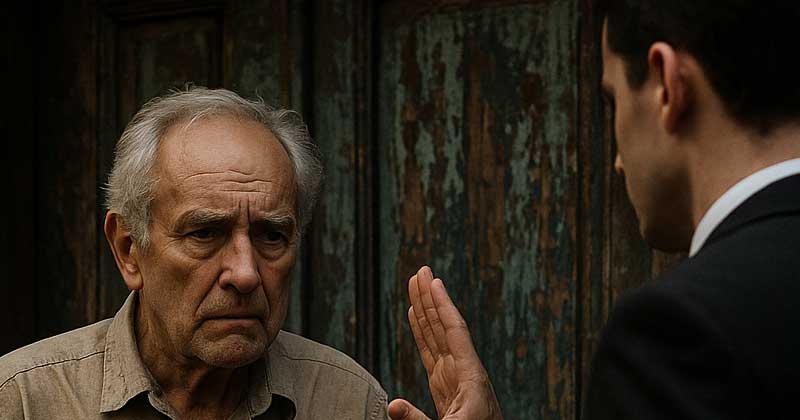
The old man stood still. It was as if the wind had stopped, and the sea had fallen silent in the face of that revelation. To him, it had only been a support for his nets, but in the professor’s eyes, it was a priceless treasure, laden with stories from long ago.
The professor continued:
— This iron was forged by the hands of warriors who passed through these waters. The sword from which it comes would have belonged to a Viking leader. Only a few fragments like this exist in the whole world.
In the small yard of the fisherman, everyone present listened with bated breath. Neighbors, gathered curiously at the fence, murmured among themselves like at an old gathering, when the big news spread from mouth to mouth faster than the ringing of the village bells.
The old man ran his rough palm over the rusty surface, remembering the years when he carelessly lifted it, laying his nets out to dry. In an instant, that mundane object had transformed into a bridge between him and his ancestors, between his simple life and a history he had never known.
— And I who thought for so long that it was just a piece of iron, he whispered, his voice low.
The professor smiled warmly:
— Sometimes, the greatest treasures are hidden in the most modest places.
In the following days, the story spread throughout the village and then reached the entire country. Journalists, historians, and tourists came to see for themselves the “fisherman’s piece of iron.”
The old man, overwhelmed by the attention, wondered if it was all a dream. For him, the world remained the same: the sea, the boat, and the nets. But people now looked at his yard as if it were a museum, and he, without having wished for it, had become the keeper of a lost history.
And then something unexpected happened. The professor proposed that he donate the relic to the university museum, so that everyone could understand its value. The old man was silent for a long time. In his eyes, there was no greed, only a deep unease.
— Professor, he said after a while, I don’t have many things in this world. But this iron has been here with me for three decades. It has seen my children grow, listened to the storms of the sea, and held the nets that fed my family. If it is truly a treasure, then perhaps its place is here, among simple people, not just within the walls of a museum.
His words shook the hearts of those present. In that decision, one could feel the wisdom of the Romanian village, where even the greatest discoveries intertwine with the roots of everyday life.
The professor understood. Thus, an agreement was born: the relic would remain in the village, but the museum would support the community with resources, so that children could learn about history without leaving their hometown.
Soon, the old man’s yard became a place of pilgrimage. Students, tourists, and researchers gathered there. The village, once forgotten by the world, came to life. Fresh fish, warm pretzels, and homemade spirits were sold in the streets, and in the evenings, people sat around the fire sharing stories, just as they had always done.
The old man watched everything with moist eyes, thinking that perhaps fate had chosen him to guard that piece of iron until the world was ready to discover its story.
And, on a quiet evening, as the sun set over the waves, he placed his hand on the bar, murmuring:
— You were just a support for my nets, but you brought light to the entire village.
Thus, what had once been just a rusty piece of iron became a symbol of a simple and profound truth: that sometimes, the greatest treasures are not those that shine, but those that endure in silence, waiting to be rediscovered.
This work is inspired by real events and people, but has been fictionalized for creative purposes. Names, characters, and details have been changed to protect privacy and enhance the narrative. Any resemblance to real persons, living or dead, or to real events is purely coincidental and not intended by the author.
The author and publisher do not assume responsibility for the accuracy of events or for the portrayal of characters and are not liable for any misinterpretations. This story is provided “as is,” and any opinions expressed belong to the characters and do not reflect the views of the author or publisher.


