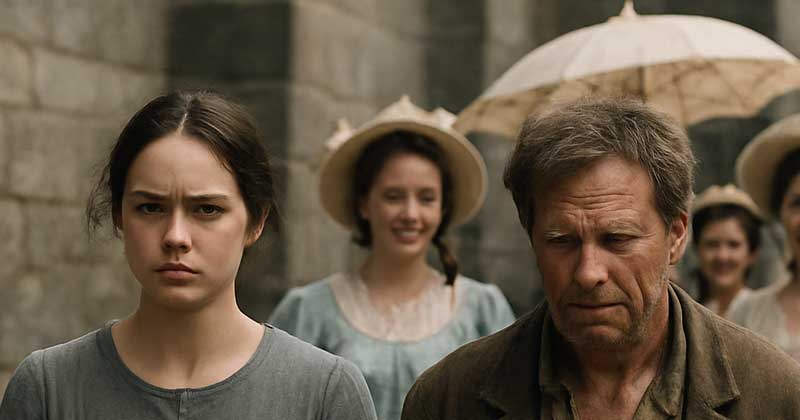
Clara hesitated to respond. She felt embarrassed by the unexpected attention and the heavy steps of the man who seemed to lighten her burden effortlessly.
— To the Valero house, sir… —she said softly, as if afraid to utter the name that brought so many mocking glances in the village.
He gave her a long, penetrating look, but said nothing. He just smiled, a warm and mysterious smile that unsettled her more than she wanted to admit.
The road to her house was long and silent, broken only by the song of crickets hidden in the scorched grass and the creaking of wood from the buckets.
Arriving in front of the homestead, Clara hurried to take the buckets, embarrassed that her mother might see her accompanied by a man. But the man raised his palm and stopped her.
— Allow me to carry the water to the yard.
She did not dare to resist. In the village, such gestures were rare, especially for someone like her.
Clara’s mother, a woman with cold eyes and tight lips, greeted them at the gate. Her sharp gaze fell on the stranger, measuring him with suspicion.
— Who is this gentleman? —she asked curtly, ignoring her daughter.
— A traveler, ma’am —he replied politely, setting the buckets down—. I thought it appropriate to help the young lady.
Clara felt her cheeks flush. However, her mother did not seem impressed.
— Young lady? —she laughed ironically—. A girl past her prime and useless. Don’t waste your time with her, sir.
The man did not flinch. On the contrary, his smile deepened, and his voice became even calmer.
— Sometimes, what the village casts aside is precisely what holds the most value.
Clara stood frozen. Never had anyone spoken about her in such a way.
In the following days, the stranger —who introduced himself as Ion — appeared more frequently in the village. He claimed to be a cattle trader, but few knew where he had come from. He had the air of a man accustomed to wandering the world, yet his eyes hid stories that no one could read.
The villagers, curious and gossipy as they were, began to watch him closely. And, to everyone’s surprise, Ion seemed to always direct his steps toward Clara.
At first, the women in the village laughed at her, saying that the stranger was just mocking her. But as days turned into weeks, and Ion continued to accompany her to the well, bring her firewood, and sit with her in the evenings on the bench in front of the house, the laughter faded.
Soon, the news that Ion had asked Clara to be his wife spread like wildfire. The entire village trembled. How was it possible for the girl scorned by all to become a bride before the other girls?
The wedding was hastily prepared, following local customs. Musicians were called, tables were laden with sarmale, pies, and red wine from old barrels. The whole village gathered, but not out of joy, rather out of curiosity and perhaps even envy.
On the wedding day, Clara appeared dressed in a simple white dress, inherited from an aunt. Her hair tied back and tearful eyes did not hide her emotions.
But Ion, with his steely gaze, looked at her as if she were the most beautiful woman in the world.
When the priest asked if he accepted her as his wife, he pronounced a firm “Yes,” and his voice resonated over all those present.
Clara felt the whole world collapse and be reborn at the same time. For the first time in her life, she was no longer “the burden of the family,” but the woman desired by a man in front of the entire village.
However, right in the middle of the celebration, a disturbing detail began to emerge. An old man from the village, who had been watching Ion closely, whispered to those around:
— This man is not who he says he is. I have seen him before, many years ago… but not as a cattle trader, rather as a bandit.
The murmur spread quickly, like a flame in dry straw. The entire village began to stir, and eyes turned once again toward Clara.
But she, holding Ion’s hand, lifted her gaze and for the first time in her life faced all the mocking eyes.
— Perhaps he is not who he says he is —she said loudly—, but for me, he is the man who chose me when all of you cast me aside.
The silence that fell over the crowded yard was more powerful than any music.
And thus, on that day, Clara Valero —the scorned girl of the village— became not just a wife, but also a woman who had learned to hold her head high, even in front of those who wished her downfall.
This work is inspired by real events and people, but has been fictionalized for creative purposes. Names, characters, and details have been changed to protect privacy and enhance the narrative. Any resemblance to real persons, living or dead, or to real events is purely coincidental and not intended by the author.
The author and publisher do not assume responsibility for the accuracy of events or for how characters are portrayed and are not liable for any misinterpretations. This story is provided “as is,” and any opinions expressed belong to the characters and do not reflect the views of the author or publisher.


